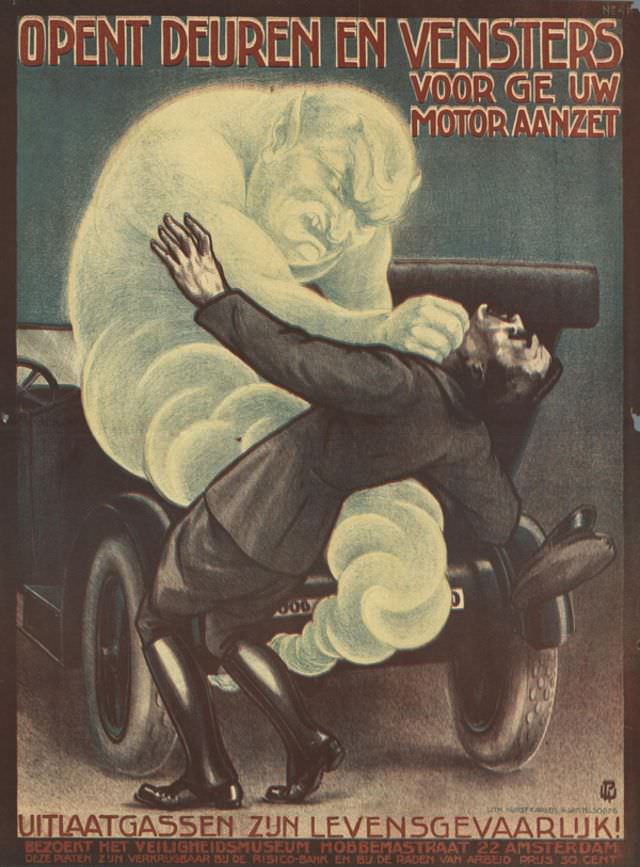
Bold Dutch lettering shouts a warning across the top—“Opent deuren en vensters voor ge uw motor aanzet”—as a ghostly plume of exhaust swells into a looming figure behind an early motorcar. The illustration turns carbon monoxide into an almost human threat, curling out of the vehicle in pale, muscular spirals that dwarf the well-dressed driver. It’s a striking piece of 1920s graphic design: dramatic, legible, and built to stop a passerby in their tracks.
Willem Papenhuyzen’s artwork from 1925–1926 leans into allegory rather than technical instruction, making the invisible danger of fumes feel immediate and physical. The composition reads like a cautionary tale staged in the street or garage, with the driver caught at the moment of vulnerability—engine running, air trapped, danger rising. Even without knowing the original publication context, the message is unmistakably public-safety minded and tailored to an era when cars were becoming familiar fixtures of daily life.
At the bottom, the emphatic line “Uitlaatgassen zijn levensgevaarlijk!” reinforces the central theme: exhaust gases can be deadly, especially in enclosed spaces. For readers interested in vintage posters, motoring history, and early safety campaigns, this image offers a memorable window into how artists and institutions communicated risk before modern signage and regulations became commonplace. It also highlights how illustration, typography, and moral urgency combined in the interwar period to shape everyday behavior around new technologies.