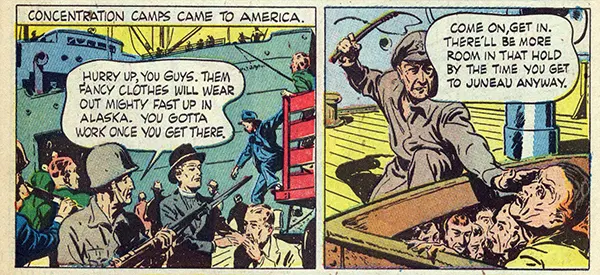
Bold, lurid panels like these made “Is This Tomorrow: America Under Communism!” a lightning rod of Cold War-era propaganda art, turning political anxiety into a fast-moving comic-book nightmare. The artwork leans hard on fear and urgency, pairing blunt captions with crowded scenes to suggest a sudden collapse of ordinary life. Its sensational style—heavy outlines, stark colors, and compressed drama—was designed to be read quickly and felt deeply.
One frame declares that “concentration camps came to America,” thrusting the viewer into a chaotic roundup where armed figures herd frightened civilians, while the dialogue reduces human beings to baggage and quotas. The second panel narrows in on a grim transport scene, with a guard’s taunt about “more room” and a mention of Juneau and Alaska that underscores the threat of exile and disappearance. Faces are drawn in panic and resignation, amplifying the message that no one is safe once the machinery of control begins to turn.
As a historical artifact, this piece is less a report of events than a window into 1940s American anti-communist fears—how suspicion and ideology could be packaged as mass-market entertainment. The comic’s visual language borrows from crime and war storytelling to sell a political warning, making it useful today for studying propaganda, media persuasion, and the cultural mood of the early Cold War. For readers searching for “Is This Tomorrow comic,” “America under communism,” or “1947 propaganda art,” these panels offer a vivid, unsettling glimpse of how fear was illustrated and circulated.