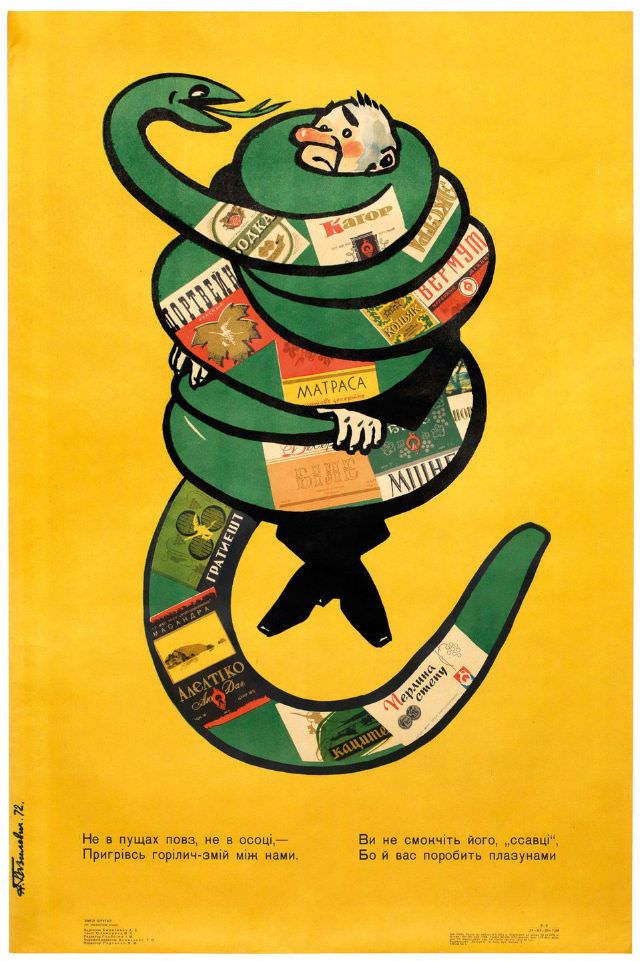
A bright yellow field sets the stage for a striking 1972 poster where a green serpent coils tightly around a suited man, its tongue flicking as the victim grimaces and struggles. The snake’s body is collaged with recognizable print graphics and Cyrillic lettering—labels and titles that read like everyday reading material turned into scales—suggesting that the danger is not wild or distant but wrapped in the familiar. The composition is simple, almost cartoonlike, yet the message lands with the clarity of a warning sign.
Rather than lurking “among trees or grasses,” the serpent in the title has “warmed up among us,” and the illustration leans hard into that metaphor: the predator feeds on attention, comfort, and habit. By clothing the snake in newspapers and magazines, the artist hints at persuasion, rumor, ideology, or addictive consumption—whatever gets under the skin and tightens slowly until it’s hard to breathe. The bottom text in Cyrillic reinforces the moralizing tone, turning the scene into a cautionary tale aimed at “mammals” tempted to “suck on him” and become reptilian themselves.
For readers interested in Soviet-era graphic art and propaganda-style illustration, this artwork offers a vivid example of how fear and satire could be blended into an accessible public message. The bold color palette, exaggerated anatomy, and collage-like typography make it instantly readable on a wall while rewarding close inspection of the printed fragments embedded in the serpent’s coils. As a historical image, it’s a reminder of how visual culture translates anxieties of its time into symbols that still feel unsettlingly current.