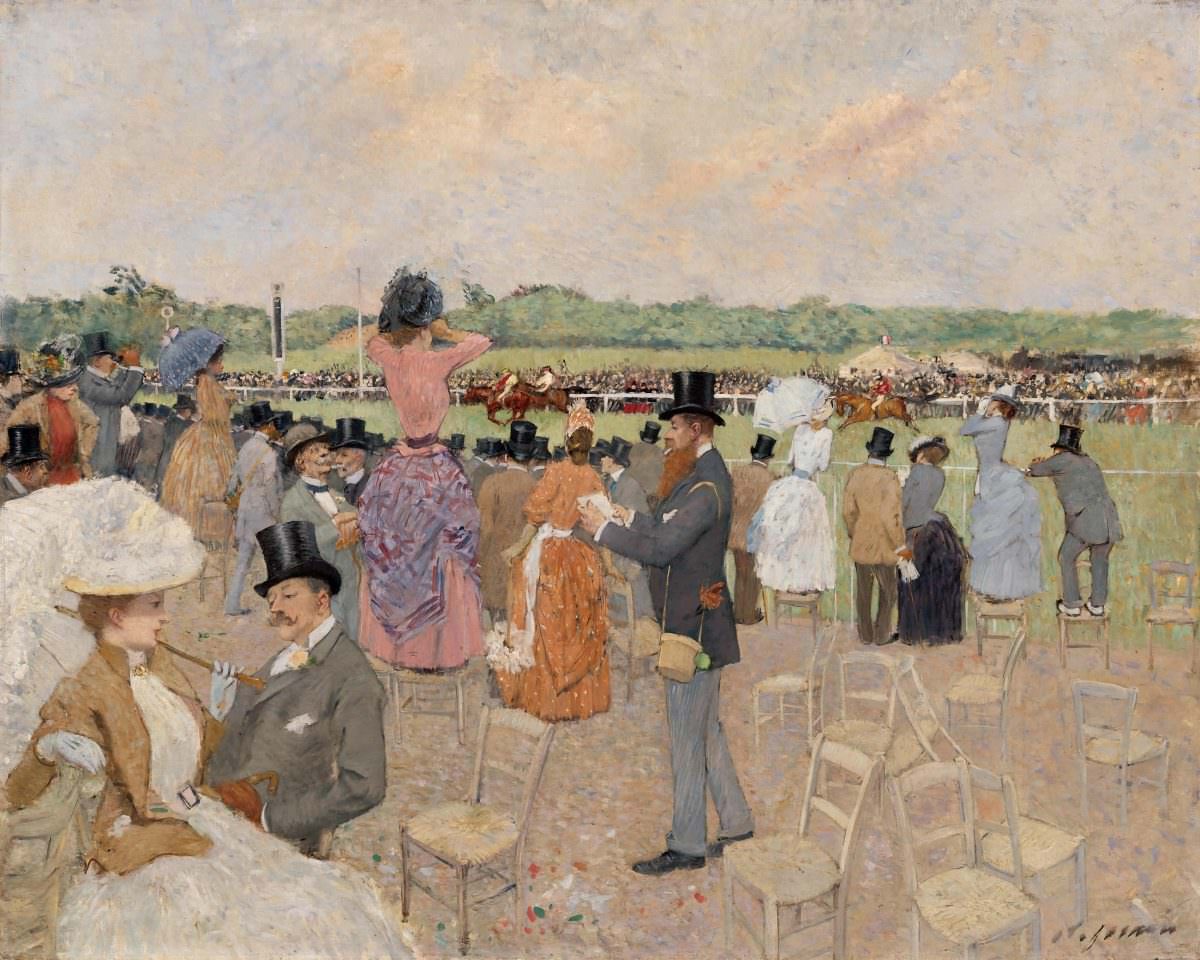
Crowds press up to the rail at Longchamp, their attention split between the thundering horses in the distance and the theatre of society in the foreground. Jean-Louis Forain’s 1891 scene relishes that double spectacle: a blur of racing action beyond the track, and a sharply observed parade of hats, tailored coats, and layered dresses near the viewing stands. The open sky and broad sweep of green give the composition breathing room, while the concentrated band of spectators anchors the excitement.
Fashion becomes a kind of commentary here, with towering top hats and extravagant women’s headwear punctuating the crowd like punctuation marks. A few figures perch on chairs to gain height, turning everyday furniture into improvised grandstand seating, and the empty chairs scattered nearby hint at constant movement—people shifting for a better view, a better conversation, a better moment. Forain’s brushwork suggests sound and motion without spelling everything out, letting the viewer feel the hum of the race day.
Beyond its charm as a horse racing artwork, “The Races at Longchamp” works as a social snapshot of late 19th-century leisure, where status and spectatorship are inseparable. The jockeys and horses are present, yet the real drama lives among the onlookers—glances, postures, and the choreography of being seen. For collectors and art history readers alike, this Forain painting offers an elegant, SEO-friendly window into Longchamp’s racing culture and the period’s vivid public life.