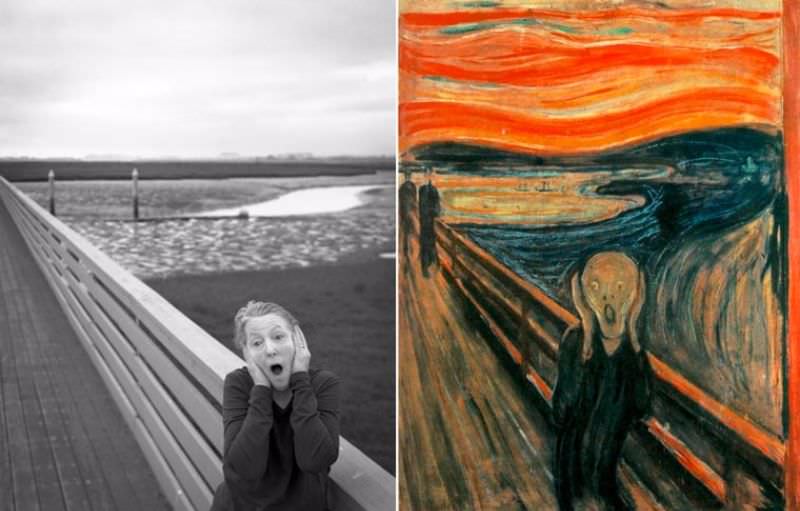
Across a stark waterfront walkway, a lone figure grips their face in a silent, startled pose, echoing one of modern art’s most unforgettable gestures. The strong diagonal of the railing pulls the eye into the distance, where a flat horizon and muted sky turn the scene into a stage for raw emotion. Set beside Edvard Munch’s iconic composition, the pairing invites viewers to notice how a simple stance can carry the same anxious charge as a masterpiece.
Munch’s “The Scream” remains a touchstone of Expressionism, not because it records a literal event, but because it visualizes a feeling—panic, dread, overwhelm—made visible in swirling color and compressed space. The blood-orange sky and dark, curving landscape seem to vibrate around the central figure, while two distant silhouettes on the bridge heighten the sense of isolation. It’s an image that reads instantly, yet rewards slow looking, as every line appears to bend toward a single psychological point.
Placed together, the contemporary-looking photograph and the famous artwork become a conversation about how we recognize emotion across time and media. For readers searching for Edvard Munch, The Scream painting, or the history of Expressionist art, this post offers a vivid reminder that the work’s power lies in its universality rather than its specifics. Whether encountered in a gallery, a book, or a shared visual comparison like this, “The Scream” continues to translate inner turmoil into a scene you can’t easily forget.