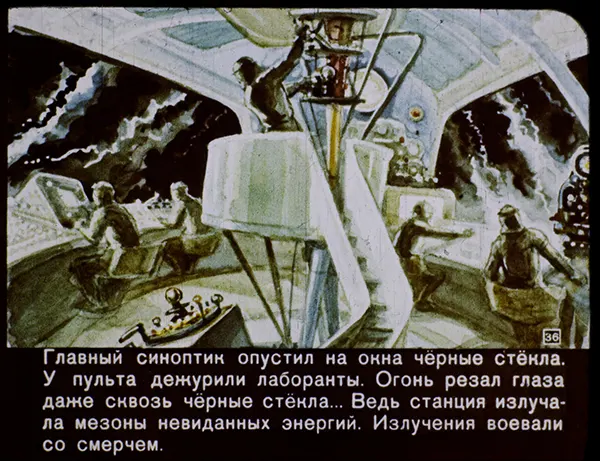
Inside a domed control room, technicians cluster around consoles while a tall instrument tower rises from the center like a ship’s mast. The painting’s perspective pulls the eye across slanted panels, cables, and gauges toward the arched windows, where dark, roiling clouds press close. Even without motion, the scene hums with urgency—hands poised, bodies leaning forward, everyone braced for whatever the sky is about to deliver.
Russian caption text along the bottom frames the drama: a chief meteorologist lowers black glass over the windows as a sudden burst of light flares, and the station “radiates” invisible meson energy to fight tornadoes. That blend of laboratory procedure and almost mythic weather warfare places the artwork firmly in the tradition of mid-century science-fiction illustration, where bold technology promised mastery over nature. The muted greens and grays, punctuated by bright highlights, heighten the sense of a storm-lit interior where safety depends on precise control.
For readers interested in retro futurism, meteorology history, and Cold War–era visions of climate intervention, this image offers a vivid snapshot of how artists imagined storm control before satellites and supercomputers became commonplace. It’s less a literal documentary photograph than a period-flavored narrative scene—part scientific briefing, part disaster thriller—designed to make the viewer feel the glare through darkened glass. As a WordPress post feature, it’s rich with searchable themes: Soviet sci-fi art, weather technology, tornadoes, experimental energy, and the aesthetics of command centers under pressure.