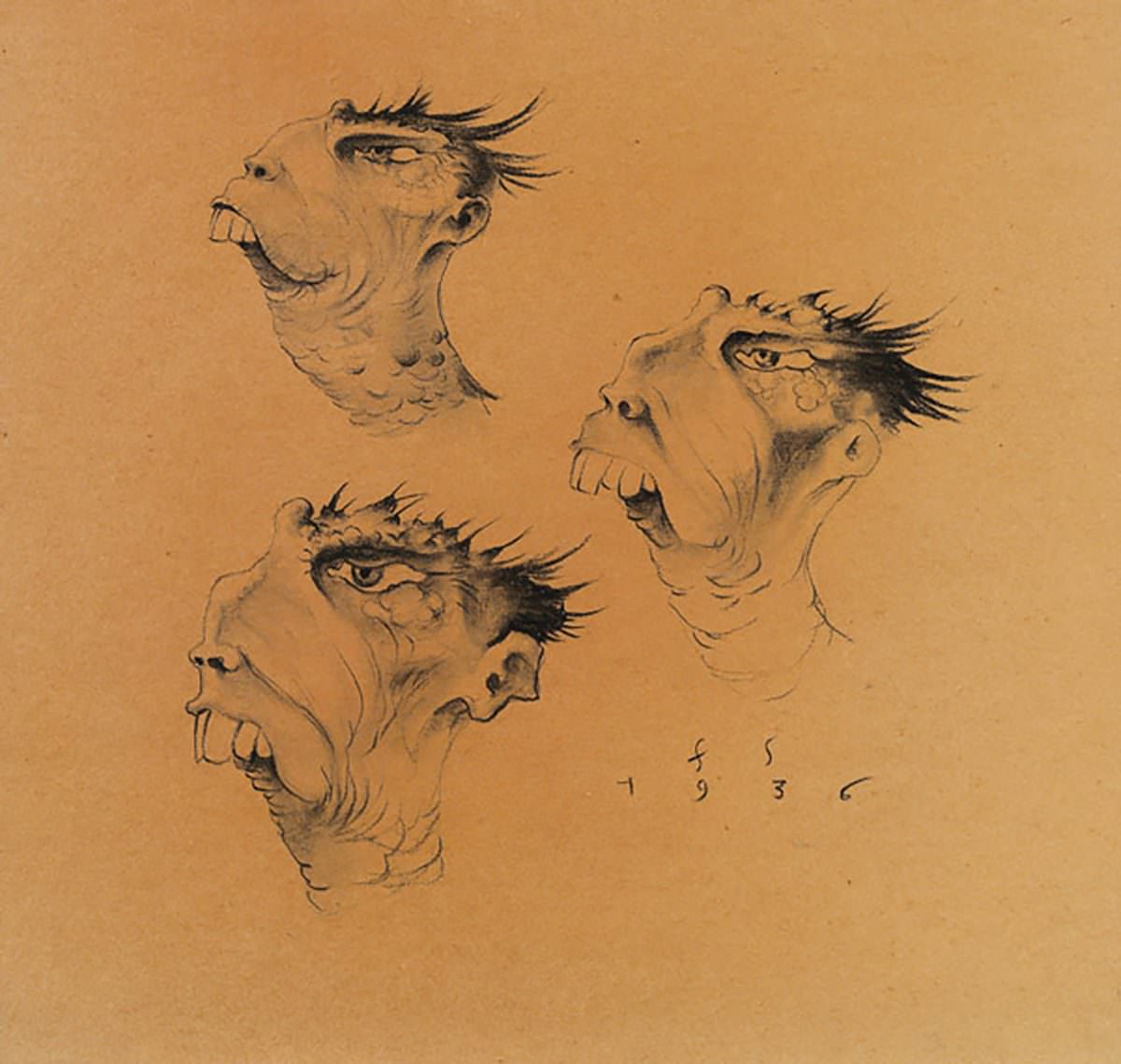
Three distorted heads float across a warm, paper-toned ground, rendered in quick, searching strokes that feel halfway between caricature and anatomy lesson. Each profile pushes the same grimacing mouth and heavy-lidded eye into a new angle, as if the artist is testing how far expression can be bent before it breaks. The sparse composition leaves room for the viewer’s imagination, turning these “imaginary heads” into studies of mood as much as form.
Drawn as a study in 1936, the work reads like a page from a sketchbook where observation meets invention. Jagged hair, exaggerated teeth, and sagging folds of skin are modeled with shading that suggests volume, while unfinished lines and open spaces reveal the artist’s process. Small marks near the lower area resemble notation, reinforcing the sense that this was made for experimentation rather than polish.
For readers interested in 1930s art and drawing practices, “Imaginary Heads, Study, 1936” offers a striking example of figure study without a sitter—an exercise in expression, structure, and the human face turned strange. The repeated variations invite close looking: how a single feature shifts character when the cheekbone changes, when the jaw drops, when the brow tightens. As a historical artwork image, it’s an evocative reminder that the sketch—restless, direct, and unguarded—can be as revealing as any finished piece.