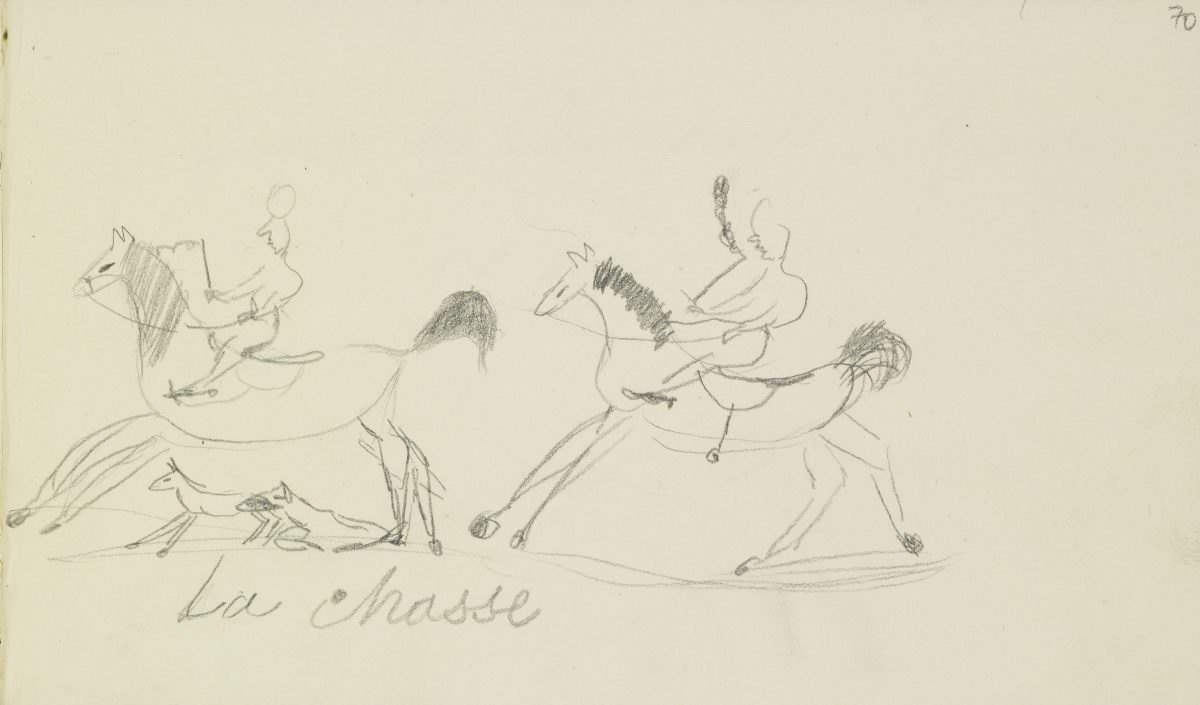
Across a wide, quiet sheet of paper, two riders lean forward on galloping horses, their bodies reduced to lively, confident pencil lines. Princess Victoria’s “La chasse” sketches the thrill of pursuit with a remarkable economy: a few strokes for legs stretched in motion, a darkened mane and tail, and a lifted arm that suggests command and urgency. Beneath the hooves, small animals dart along the ground, anchoring the scene in the traditional imagery of the hunt.
Pencil shading is used sparingly but effectively, especially where the horses’ heads and tack are indicated with darker, firmer marks. The drawing’s openness—so much white space around the action—amplifies the sense of speed, as if the riders are about to race off the page. Even without detailed faces or landscape, the artist captures posture and momentum, letting gesture do the storytelling.
“La chasse” also reads as a glimpse into aristocratic pastimes and the way they were imagined or remembered in art, where hunting scenes carried both sport and symbolism. For readers searching for Princess Victoria pencil drawings, historical sketches, or equestrian art studies, this work offers an appealing, intimate example of draftsmanship. It’s less a finished tableau than a spirited note in graphite—an instant of movement preserved with a light hand.