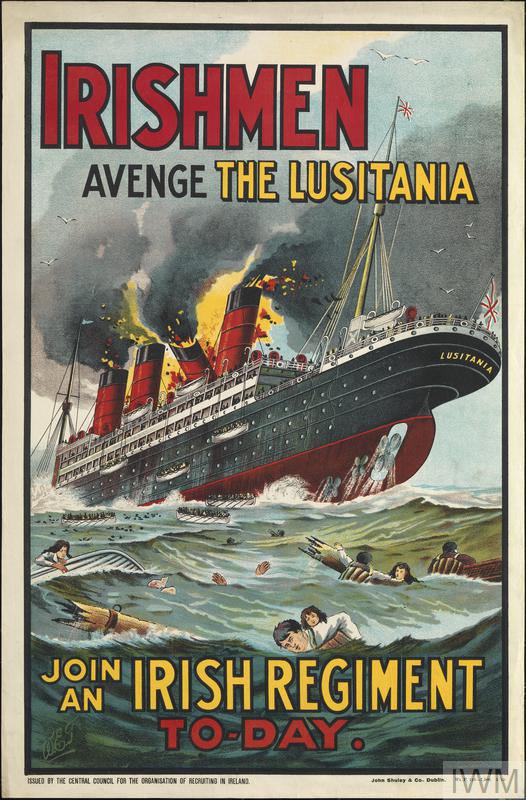
Bold, urgent lettering—“Irishmen Avenge the Lusitania”—crowns a dramatic recruitment poster that turns maritime disaster into a rallying cry. The artwork places a famous ocean liner at a steep, doomed angle as flames burst from its funnels and smoke billows across the sky, while seabirds circle above the chaos. Below, a churning sea fills with desperate survivors clinging to wreckage, their outstretched arms drawing the viewer into the catastrophe the text demands be answered.
Color and composition work like propaganda in motion: the ship’s dark hull and bright red funnels dominate the frame, pulling the eye from the burning decks down to the human figures scattered in the water. The word “LUSITANIA” is visible on the vessel, anchoring the scene’s message without needing additional explanation, while “JOIN AN IRISH REGIMENT TO-DAY” delivers the intended next step in stark, persuasive type. Rather than a neutral depiction, the poster leans on shock, sympathy, and anger to translate tragedy into enlistment.
For readers interested in World War I-era Artworks, this piece is a striking example of how illustrated posters shaped public feeling and national identity through selective storytelling. It reflects a moment when the sinking of the Lusitania became a symbol invoked far beyond the sea itself, used to frame service as both justice and duty. As a historical image, it rewards close viewing—every plume of smoke, wave crest, and typographic emphasis reveals how visual culture recruited hearts as much as bodies.