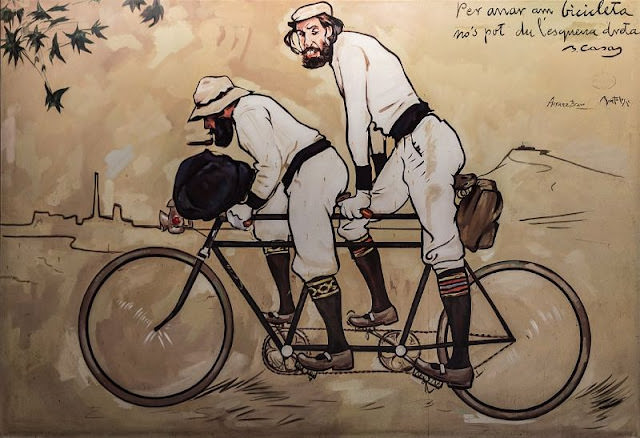
Two men in light riding clothes balance on a long tandem bicycle, their bodies angled forward as if the next push of the pedals will send them gliding out of the frame. One rider hunches low over the handlebars while the other looks back toward the viewer, his expression alert and slightly amused; caps, tall boots, and strapped bags suggest both practicality and style. The background is kept spare—just a wash of earth tones, a hint of landscape, and a few leaves—so the eye stays on the elegant lines of the machine and the camaraderie of the pair.
Set in 1897, “Ramón Casas y Pere Romeu en un tándem” reads like a snapshot of modern life arriving on two wheels, when cycling signaled speed, leisure, and urban confidence. The artist’s quick, graphic strokes outline spokes, frame, and clothing with a poster-like clarity, while the limited palette keeps the mood airy and informal. Handwritten text in the upper corner reinforces the feeling of a personal note or playful caption, as if the scene were meant to be shared among friends as much as exhibited.
For readers exploring Catalan art, modernisme, or the history of cycling imagery, this work offers an engaging intersection of portraiture and everyday technology. It’s less about a grand event than about motion, friendship, and the appeal of the new—how a tandem bicycle could become both a conversation piece and a symbol of a changing era. Whether you arrive for Ramon Casas, Pere Romeu, or simply the charm of a late-19th-century tandem, the composition delivers a vivid, story-filled glimpse into the culture of its time.