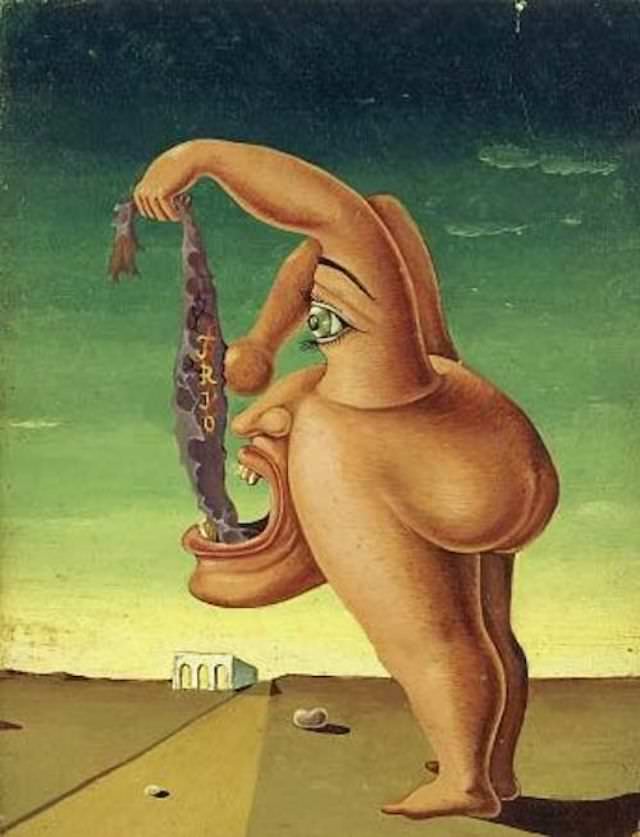
A strange, dreamlike figure dominates “Trio, 1937,” standing on an empty plain beneath a green-tinged sky. The body is rendered as a soft, sculptural mass—part human, part caricature—while a single, watchful eye anchors the profile. With an exaggerated open mouth and an upraised arm, the figure holds a limp purple form marked with the word “TRIO,” turning the scene into a visual riddle that feels both theatrical and unsettling.
Surrealism thrives on this kind of transformation, where anatomy bends into metaphor and scale becomes psychological rather than realistic. The distant block-like building and the long, sharp wedge of shadow suggest a stage set or a desert of the mind, giving the composition depth without offering a comforting sense of place. Small objects on the ground—stones or fragments—read like clues scattered across a barren landscape, emphasizing isolation and the tension between the monumental figure and its tiny surroundings.
For readers exploring 1930s art, this artwork invites an SEO-friendly conversation around surrealist painting, symbolism, and the era’s fascination with dreams and distortion. The title “Trio, 1937” hints at relationships and multiplicity, echoed in the image’s layered forms and the odd pairing of mouth, hand, and dangling emblem. Whether viewed as satire, allegory, or pure imagination, it remains the kind of historical artwork that rewards slow looking and repeated interpretation.