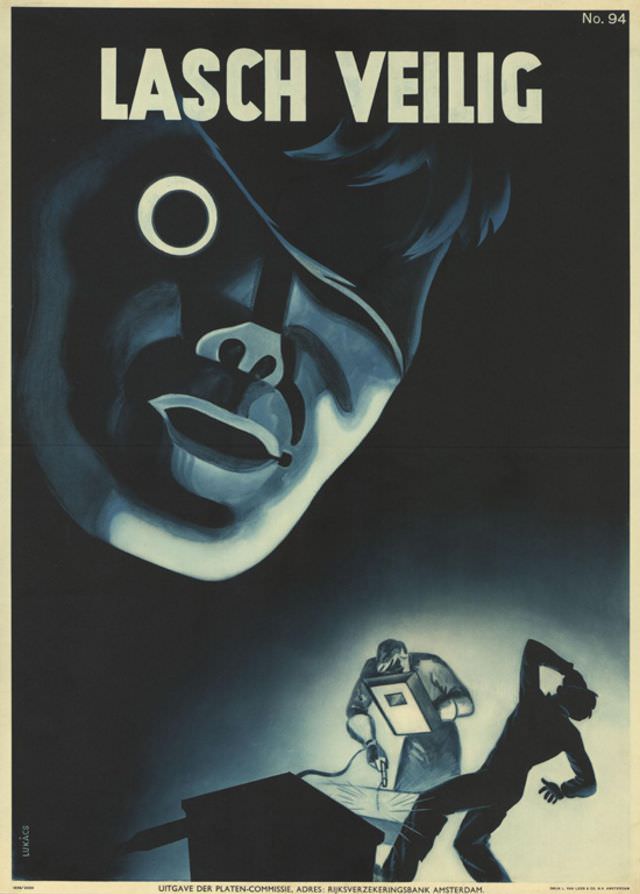
A looming mask dominates the upper half of E. Lukàcs’s 1939 poster, its pale, stylized face emerging from a field of deep shadow. Bold block lettering—“LASCH VEILIG”—cuts across the top like a warning banner, while the stark contrast and simplified forms give the design the punch of modernist graphic art. Even without additional context, the composition reads as urgent and theatrical, pulling the viewer into a world of risk and vigilance.
Below the mask, the narrative turns practical and immediate: a welder, visor down, throws bright sparks across a work surface as a second figure recoils nearby, arms raised in alarm. The diagonal beams of light and the exaggerated scale between the mask and the workers create a sense of looming danger, as though the threat is both physical and psychological. Details like the small “No. 94” marking and the fine-print publisher line at the bottom reinforce that this was part of a wider campaign of printed safety guidance.
Designed on the eve of the 1940s, the poster reflects how industrial workplaces used graphic design to teach safe practice quickly—through symbols, fear, and memorable silhouettes rather than long explanations. For readers interested in vintage posters, workplace safety history, or European modernist illustration, Lukàcs’s piece stands out for its dramatic lighting and almost cinematic staging. It remains a compelling example of how typography, minimal color, and strong imagery could turn a simple message into something hard to forget.