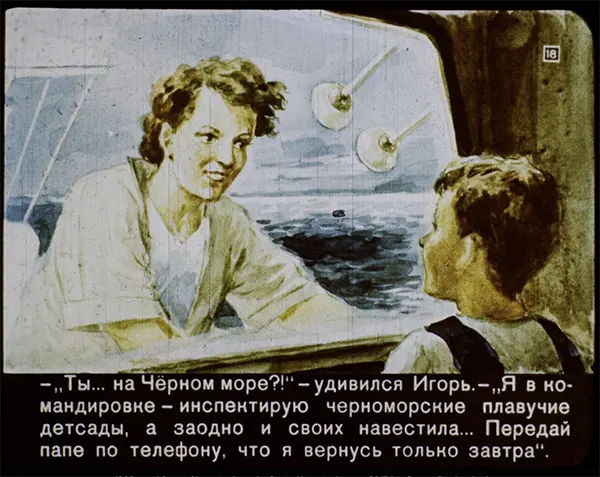
A softly tinted Soviet-era illustration sets a conversational scene at sea: a woman leans in through a cabin window, meeting the gaze of a young boy seated inside. Behind them, dark water rolls under a pale sky, while the ship’s structure frames the moment with rounded metal and glass. The Russian caption at the bottom anchors the narrative, matching the post title’s dialogue about the Black Sea and a matter-of-fact work visit.
Igor’s surprise—“Are you… in the Black Sea?”—lands like a child’s astonishment at finding family in an unexpected place, and the woman’s reply turns the encounter into a glimpse of everyday administration. The idea of “floating kindergartens” hints at an ambitious maritime world where children’s care and education could travel with crews, ports, and seasonal routes. Her calm instruction to call home adds a domestic pulse to the industrial setting, balancing warmth against the ship’s hard lines.
As historical artwork, the piece works on two levels: a story of reunion and responsibility, and a window into how the Black Sea was imagined in public culture—practical, modern, and populated by working professionals. The gentle facial expressions, the close framing, and the visible sea beyond the window make it easy to linger on details and read between the lines of the caption. For readers searching for Soviet illustration, Black Sea maritime history, or visual culture around childcare and work, this image offers a memorable, human-scale entry point.