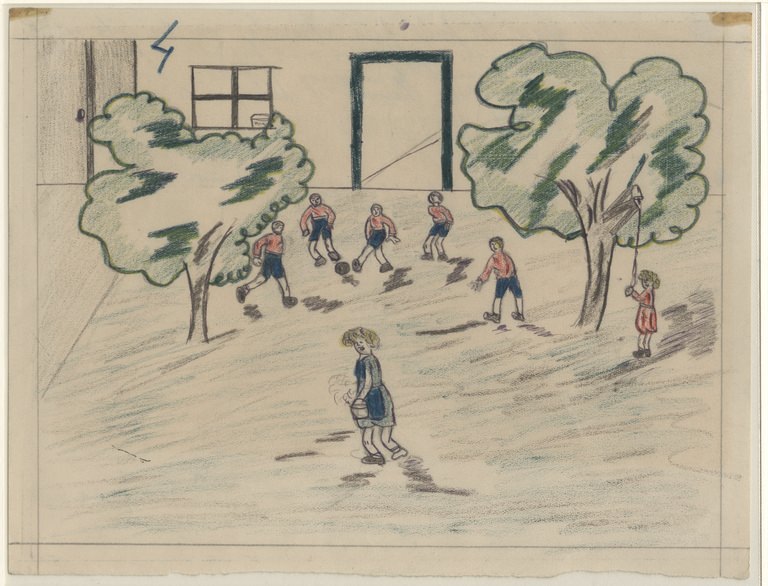
Childlike pencil strokes set a calm scene: a courtyard or open yard framed by two leafy trees, with a stark building facade, a window, and a doorway in the background. Several small figures cluster together as if playing, while one child stands apart at the edge, and another lingers in the foreground. Even without captions, the drawing’s simple lines and soft shading pull you into a remembered everyday space where routine tries to hold steady.
Placed under the title “The Spanish Civil War of 1936 through Children Drawings Artworks,” the artwork reads like a quiet counterpoint to upheaval. The absence of explicit violence is its own message, suggesting how children might record war indirectly—through fragments of normal life, watchfulness, and the emotional geography of safety and uncertainty. Details like the empty doorway and the slightly separated figures invite interpretation, hinting at disruption without needing to spell it out.
For a WordPress post exploring Spanish Civil War history, these children’s drawings offer a powerful, human-scale lens on the period, bridging art, memory, and social history. They serve researchers, educators, and readers searching for primary-source perspectives beyond official photographs and battlefield accounts. As historical artifacts, such artworks remind us that the story of 1936 is also told in playgrounds, courtyards, and the small moments children chose—or managed—to put on paper.