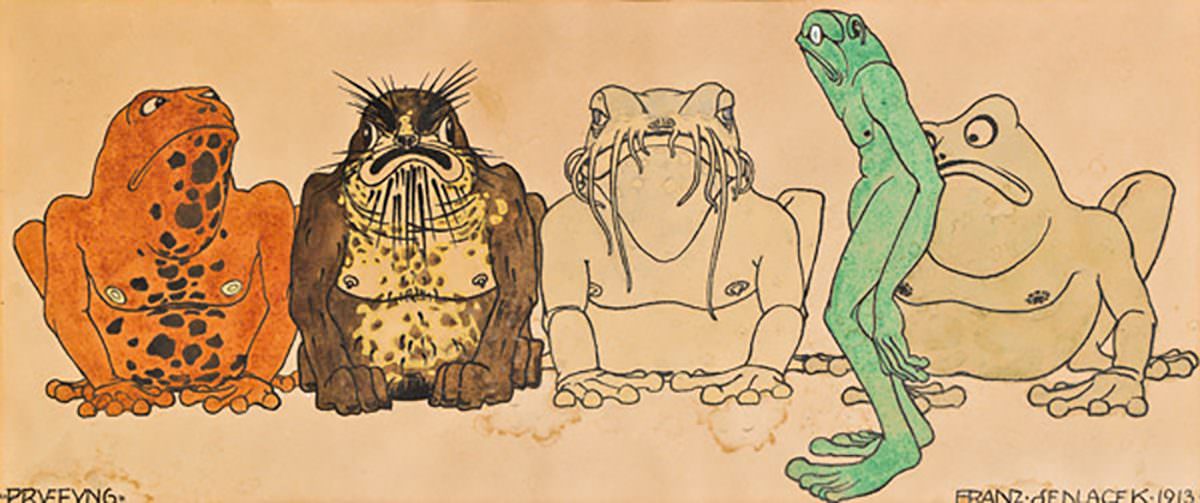
A row of squat, heavy-bodied frogs sits like a committee on a bare stage, their broad toes splayed and their eyes fixed forward. The artist exaggerates every feature—the mottled skin, sagging bellies, and stern mouths—until each creature reads as a distinct personality rather than a simple specimen. Against the warm, minimal background, the lineup feels ceremonial, as if an inspection is about to begin.
At the right edge, a tall green figure stands upright, turning its long profile toward the assembled group in a pose that suggests scrutiny and discomfort at once. That contrast in posture—one upright, the others grounded—turns the scene into a visual joke about authority, conformity, and judgment. The title, “The Audit, 1913,” steers the viewer toward a satirical reading: an accountant’s ritual translated into amphibian theater.
Marked with the year 1913, this artwork belongs to an era when caricature and stylized illustration were powerful tools for social commentary. The bold outlines and flat colors keep the composition crisp and readable, making it ideal for a WordPress feature on early 20th-century art, satire, and illustration. Whether you approach it as playful absurdity or pointed critique, “The Audit” invites a second look at who gets evaluated—and who gets to do the evaluating.