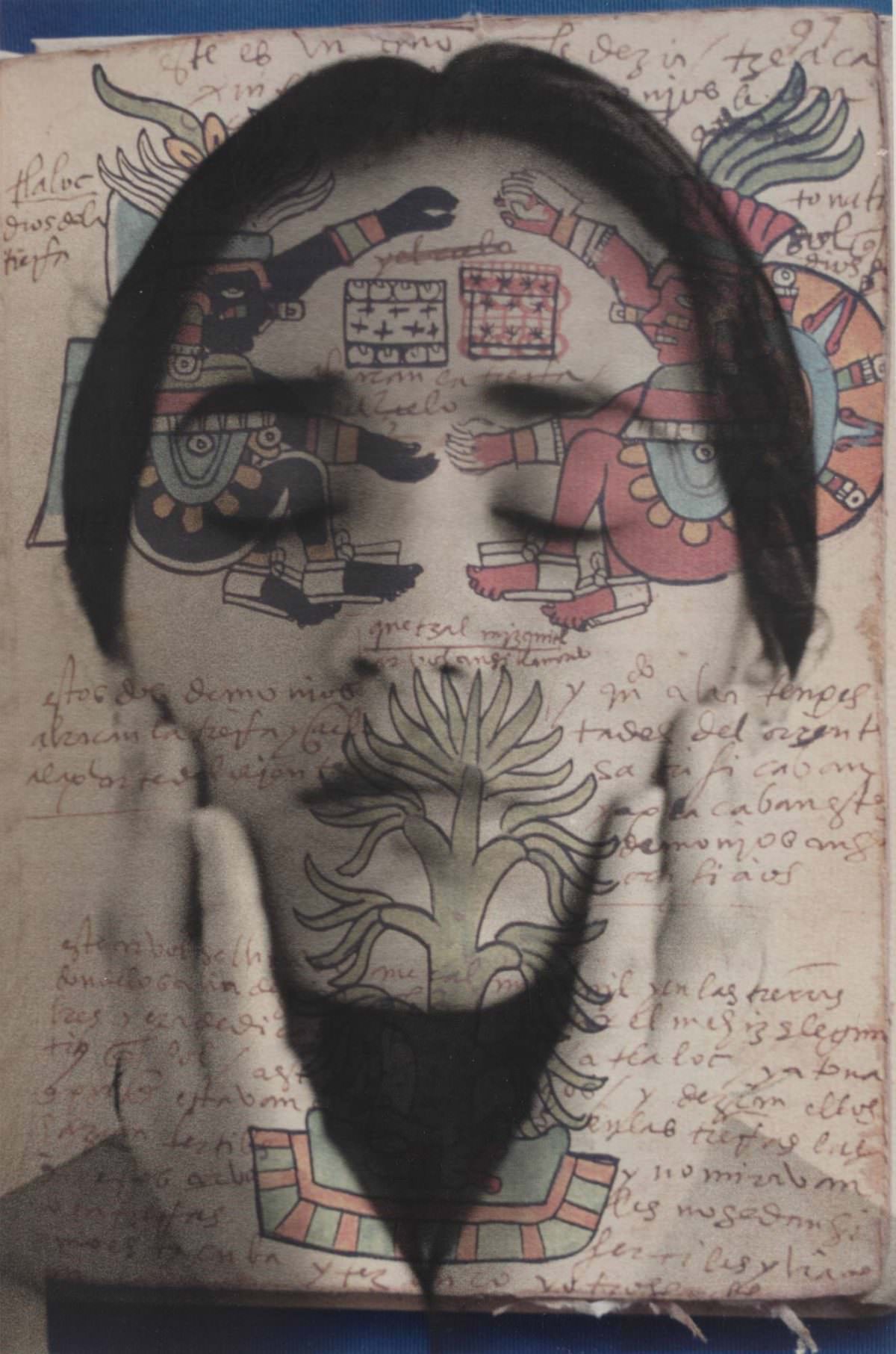
Tatiana Parcero’s *Interior Cartography* (1996) layers a softly rendered human face over a densely worked page of handwriting and vivid, codex-like figures. The effect is immediate: portraiture becomes a palimpsest, where memory, text, and symbolic imagery press through the skin. Muted grayscale features hover in front while color—reds, blues, and ochres—anchors the background with a ritual, illustrative intensity.
Across the upper field, two stylized seated figures face one another in a tense, mirrored arrangement, their gestures framing small, patterned forms between them. Cursive lines run behind and around the imagery, creating a sense of private record or inherited document, while the central botanical motif rises like a spine or internal axis. Hair and shadows blur the boundary between photograph and page, suggesting that identity here is not a single likeness but an accumulated archive.
Rather than offering a straightforward “map,” the work proposes a kind of embodied geography—an interior territory charted by culture, language, and visual inheritance. For viewers searching for Tatiana Parcero art, *Interior Cartography 1996* stands out as a compelling example of mixed-media portraiture that fuses historical manuscript textures with contemporary photographic presence. It invites a slower reading, where the eye moves between face, script, and emblem, piecing together a story that remains intentionally open.