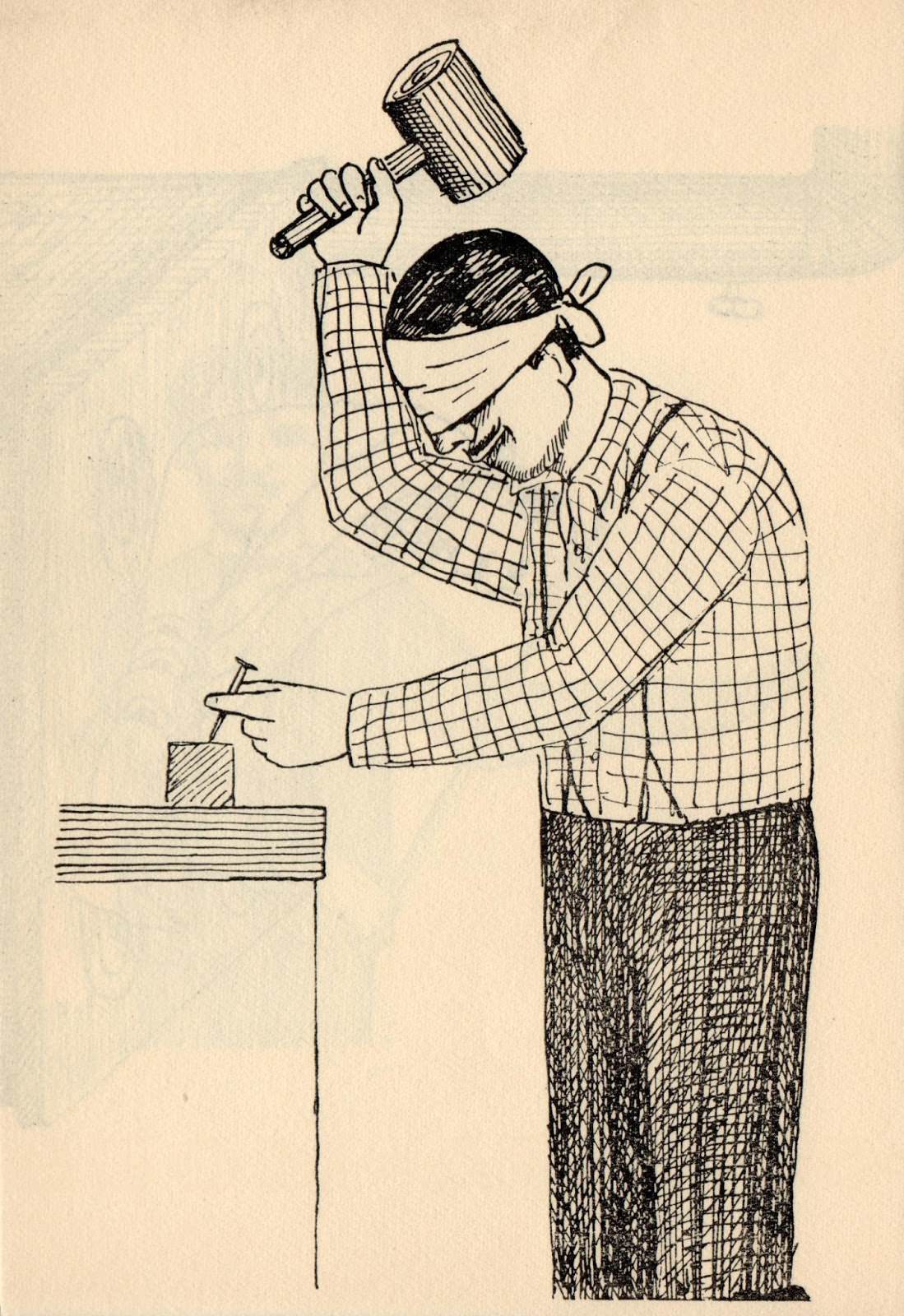
A blindfolded man stands at a workbench, one hand poised over a nail while the other raises a heavy mallet high above his own head. The simple linework turns an everyday carpentry gesture into a tense psychological scene, where precision and self-inflicted danger occupy the same moment. In the context of Roland Topor’s 1960 illustration, the image reads as a darkly comic emblem of masochism—an invitation to consider how pain, choice, and ritual can intertwine.
Ink crosshatching and spare background space sharpen the focus on the body’s choreography: the bowed head, the tightened grip, the hammer’s suspended arc. The checked shirt and ordinary trousers evoke the familiar, almost domestic world of labor, making the impending blow feel both absurd and unsettling. That friction between the mundane and the grotesque is central to Topor’s art, where surreal humor often exposes uncomfortable truths beneath ordinary routines.
Viewed today, the drawing functions as more than provocation; it’s a compact study in self-sabotage, discipline, and the strange pursuit of control through surrender. For readers searching for Roland Topor illustrations, masochism art, or 1960s dark surrealism, this piece offers a stark entry point into the era’s fascination with taboo psychology and visual metaphor. The longer you linger, the more the scene suggests that the deepest wound may be the one the figure is preparing to deliver to himself.