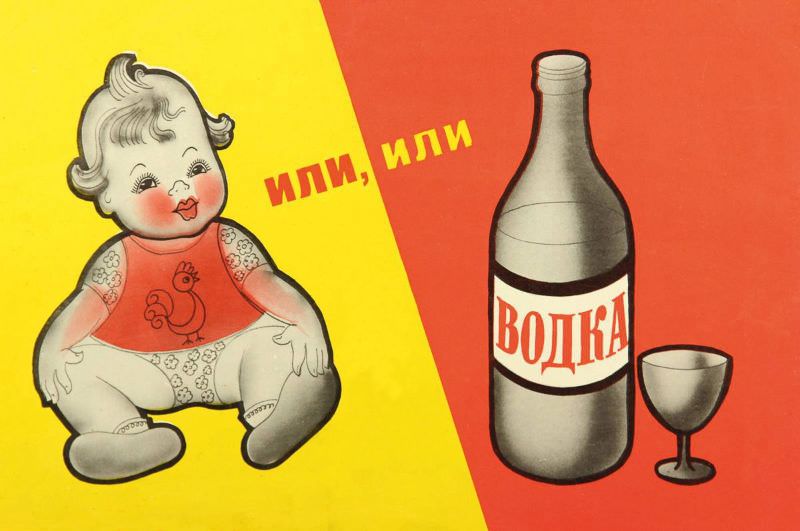
Bold blocks of yellow and red split the frame, turning a simple choice into a visual jolt: on one side a rosy-cheeked baby in a patterned romper, on the other a stark bottle labeled “водка” (vodka) with a small glass beside it. The title, “Either, or., 1983,” fits the composition’s blunt dilemma, where innocence and harm are staged as opposing options rather than a quiet warning. With its clean outlines and poster-like clarity, the artwork reads instantly, even before you take in the Cyrillic text hovering between the two halves.
Cartoon softness does the heavy lifting here—rounded limbs, a playful expression, and a bright bib-like chest panel make the child feel approachable, almost toy-like. Against that warmth, the bottle is rendered with simple shading and hard geometry, the label shouting in tall letters, the glass waiting nearby as a final punctuation mark. The contrast isn’t subtle, and it doesn’t need to be: this is propaganda-style graphic design that uses color, symmetry, and minimal detail to argue its point at a glance.
Placed in 1983, the piece lands in a period when public messaging often relied on striking, easily reproduced visuals for wall displays and print circulation. For WordPress readers browsing historical photos and artworks, it’s a compelling example of late-20th-century social poster art—part moral instruction, part cultural artifact, and entirely built for quick recognition. Whether you read it as an anti-alcohol message, a family-centered appeal, or a snapshot of Soviet-era visual language, the image remains a sharp, memorable “either/or” that still sparks discussion today.