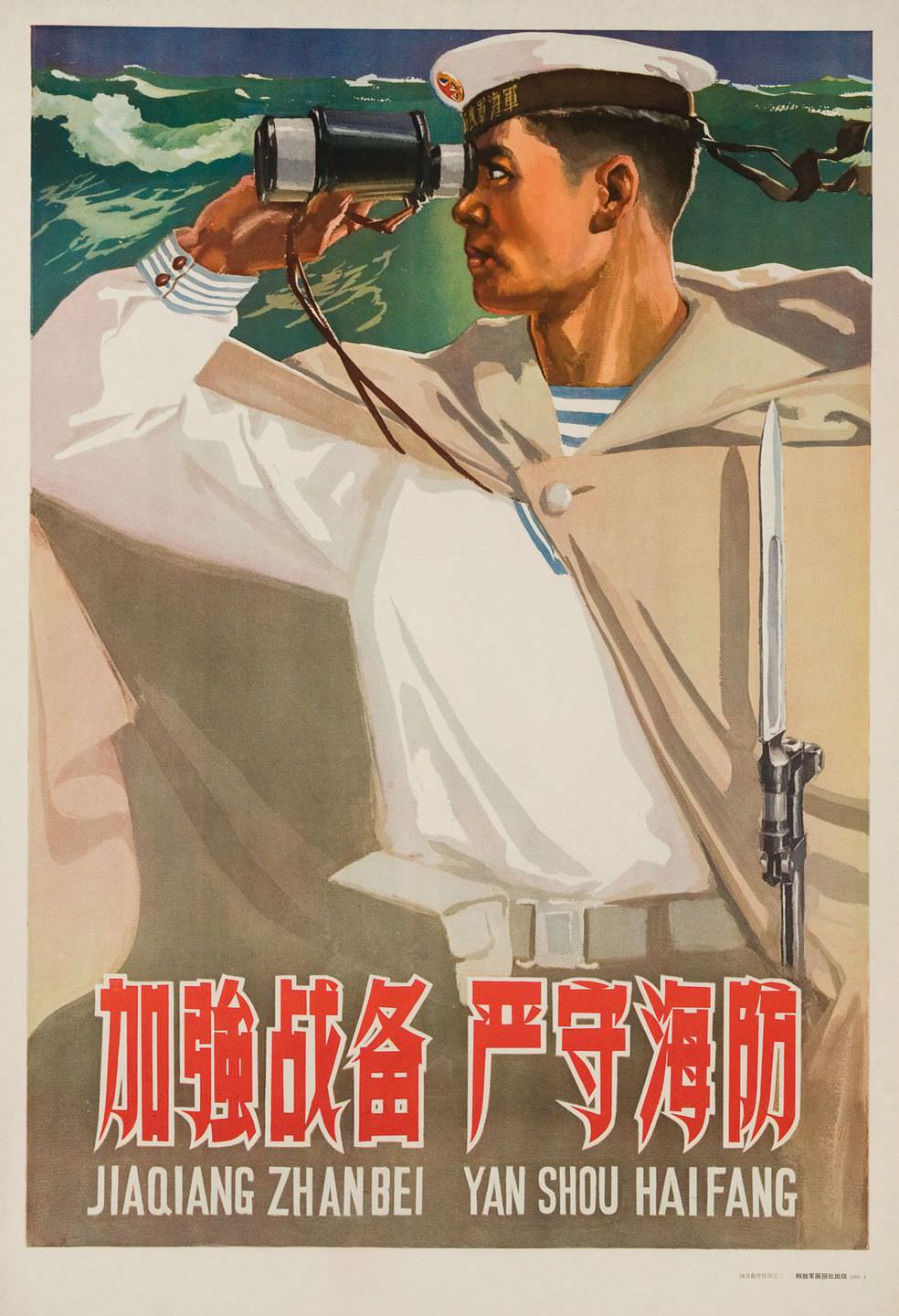
Against a restless, deep-green sea, a uniformed sailor raises binoculars and scans the horizon, his white cap and crisp jacket catching the light like a signal flag. The composition pushes the figure forward in heroic scale, with wind-tugged ribbons and rolling surf reinforcing the sense of vigilance. Bold red Chinese characters dominate the lower half, paired with a romanized slogan that reads “JIAQIANG ZHANBEI YAN SHOU HAIFANG,” underscoring the poster’s clear message of preparedness and strict coastal defense.
The title, “Enhance the Coastal Defense of the Motherland, 1962,” situates this artwork in the tense early-1960s atmosphere when coastal watchfulness and military readiness were powerful themes in public visual culture. Here, the ocean becomes both backdrop and frontier, while the sailor’s steady gaze suggests discipline, duty, and modern observation. Details like the striped undershirt and the bayonet at the right edge add to the martial identity without cluttering the design’s clean, propagandistic clarity.
For collectors and readers interested in Cold War-era propaganda art, Chinese military posters, or maritime defense imagery, this piece offers striking color, strong typography, and an unmistakable call to vigilance. It also works as a study in how poster design fuses message and motion—diagonal lines, foaming waves, and a single focused figure turning national policy into a memorable scene. Whether viewed for its historical context or its graphic power, the poster remains an evocative window into the visual language of coastal security and patriotic mobilization.