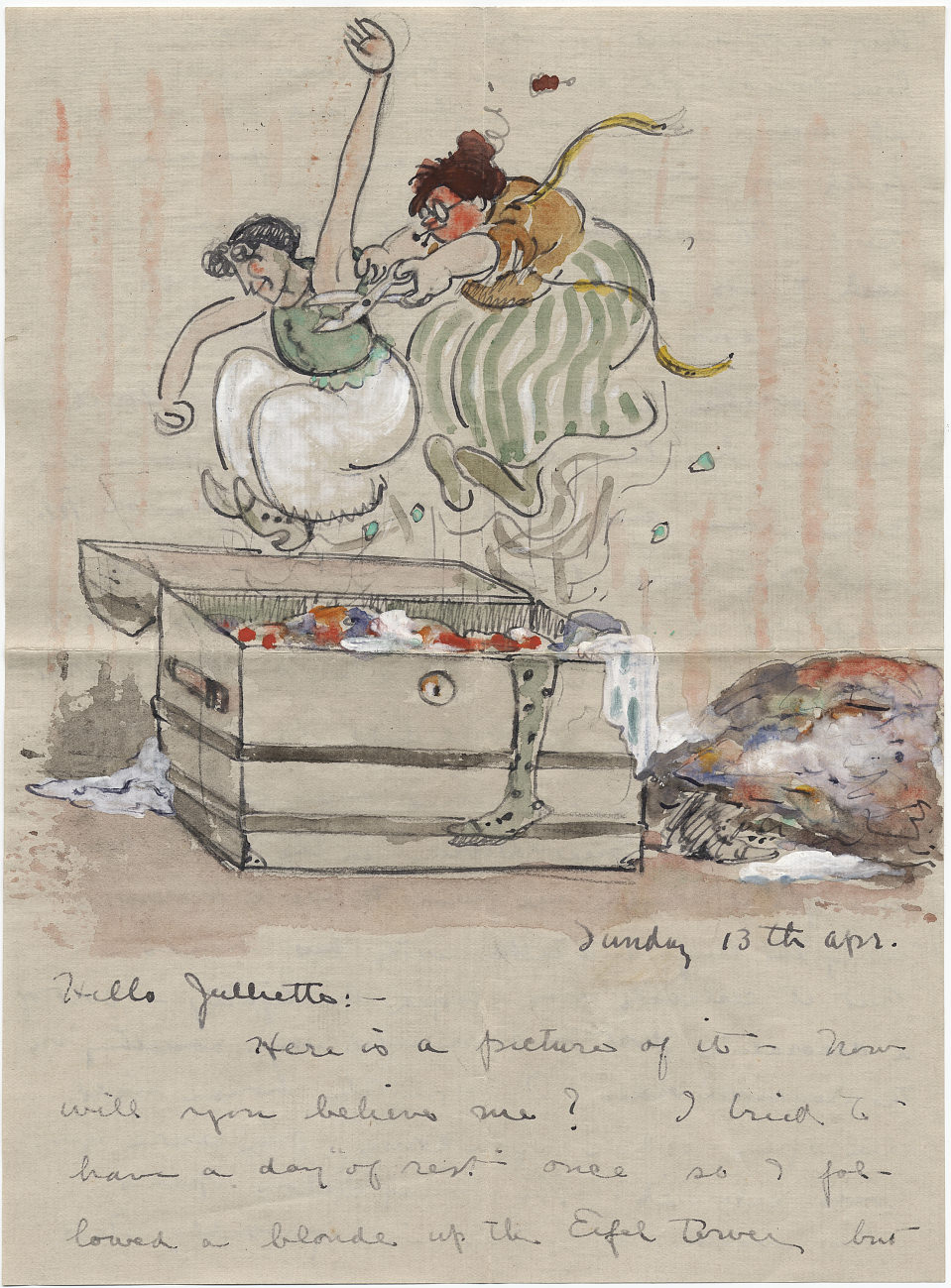
A burst of comic energy leaps off the page in Alfred Joseph Frueh’s 1913 note to Giuliette Fanciulli, where quick ink lines and soft washes turn everyday mishap into performance. Two women, skirts swirling, spring upward as if startled mid-step, while a large trunk in the foreground spills clothing and color in a jumble. The artist’s playful exaggeration—flying limbs, fluttering ribbons, and scattered fragments—creates the feel of a stage gag caught at its funniest moment.
Watercolor tints of green, ochre, and brick red sit lightly over sketchy contours, letting the drawing breathe like a doodle made in a rush of affection. The composition reads from the chaotic trunk to the airborne figures, inviting the eye to follow the implied motion and the little debris that marks the commotion. Along the lower portion, handwritten lines and a brief date-like scrawl reinforce that this is more than an artwork: it’s correspondence, a personal object that carries both image and voice.
Letters like this remind us how early twentieth-century artists blended illustration, humor, and intimacy in their private exchanges, long before “sketching in the margins” became a nostalgic phrase. For readers interested in Alfred Joseph Frueh, Giuliette Fanciulli, and 1913 ephemera, the piece offers a vivid example of art used as communication—part postcard, part cartoon, part diary. It’s the kind of historical artifact that preserves not just what was said, but how it felt to say it.