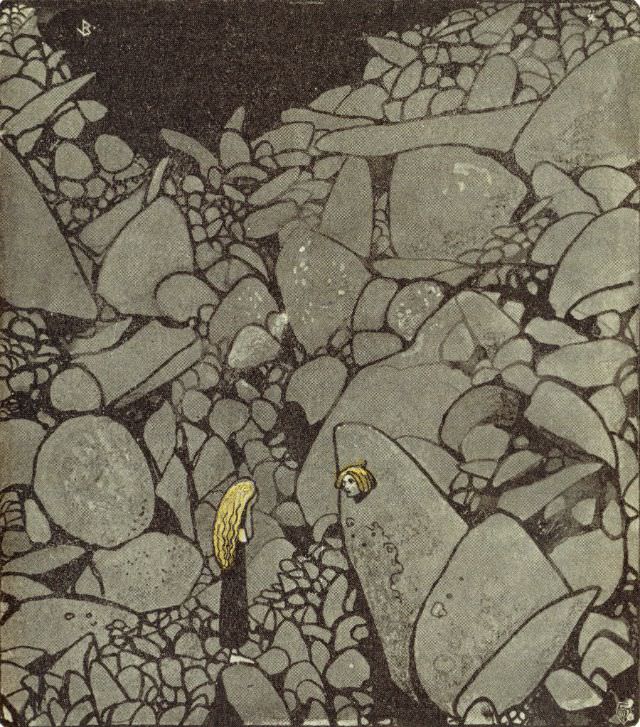
Under a towering slope of boulders and pebble-strewn shadows, two tiny figures—Dag and Daga—stand dwarfed by Sky Mountain’s stony labyrinth. The artist builds the scene from countless rounded rocks, their pale faces outlined against dark crevices, creating a textured landscape that feels both real and enchanted. Small touches of warm color in the characters’ hair pull the eye into the lower portion of the composition, emphasizing how vast and impersonal the mountain seems.
Across the image, scale does most of the storytelling: the cliff of stones becomes a world of its own, where a child’s height is reduced to a footnote in the terrain. The “Flying Troll” of the title is suggested more than declared, letting the viewer search the spaces between rocks for a lurking presence or a sudden movement overhead. That restraint gives the artwork a fairytale tension—quiet, watchful, and slightly ominous—typical of early illustrated folklore where danger can be hidden in plain sight.
Published in 1907, this piece sits at the intersection of children’s storybook art and the period’s love of decorative linework and pattern. Its careful, graphic rendering makes it an excellent example of early twentieth-century illustration, while the mythic subject matter keeps it rooted in Northern fairy-tale traditions. For readers and collectors browsing historical artwork, “Dag and Daga, and the Flying Troll of Sky Mountain” offers a striking blend of atmosphere, design, and narrative mystery that still invites slow looking today.