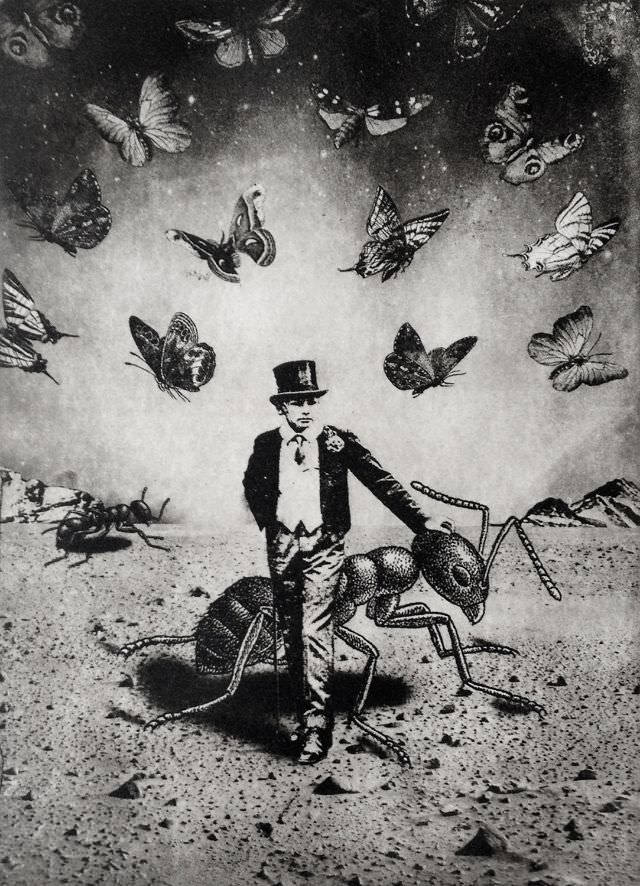
Under a sky crowded with fluttering wings, a small, formally dressed boy stands with the composure of an adult—top hat, jacket, and a pinned flower—while the world around him turns fantastical. Oversized butterflies drift across the upper half of the frame, their patterned wings rendered like cutouts against a grainy, misty backdrop. The contrast between the child’s tidy silhouette and the unruly swarm overhead gives the scene its peculiar tension, halfway between dream and stage illusion.
At ground level, the title “The Boy and The Ants” finds its startling proof: colossal ants loom beside him, their segmented bodies and jointed legs drawn with an almost scientific attention to form, only scaled beyond reason. One ant appears close enough to be a companion or a mount, while another crawls in from the left as if entering a miniature desert or rocky plain. The emptiness of the landscape amplifies the sense of isolation, turning the boy into a lone figure negotiating a world where insects have inherited the proportions of giants.
Some historical images survive not as straightforward records but as imaginative artworks that reveal the era’s appetite for wonder, trick photography, and allegory. This piece invites readers to linger on its surreal collage aesthetics—part theatrical tableau, part illustrated fantasy—where childhood curiosity meets the unsettling logic of the uncanny. Whether approached as symbolism, early visual experimentation, or simply a striking oddity for art and history lovers, it remains a memorable example of how the past could picture the impossible with complete conviction.