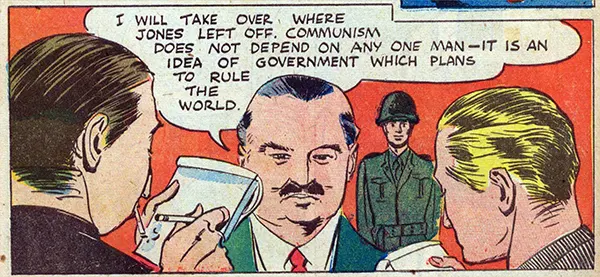
Cold War anxiety leaps off the page in this piece of comic book art, where a stern, mustached figure dominates the center of the panel while two men flank him in tense conversation. A uniformed soldier stands in the background like a warning made visible, reinforcing the sense that politics and policing have merged into a single, watchful force. The bold colors and tight framing amplify the pressure of the moment, pulling the viewer into an imagined America where private dissent feels dangerously close to a public offense.
Speech bubbles do the heavy lifting here, turning propaganda into dialogue and fear into a plot device. The text describes communism as an ideology that “plans to rule the world,” a sweeping claim that reflects the era’s popular rhetoric and the moral certainty often sold in mid-century anti-communist media. As a visual artifact, it’s a vivid example of how comics—cheap, accessible, and widely circulated—could package complex geopolitical tensions into sharp, dramatic scenes.
Browsing “Is This Tomorrow: America Under Communism!” today offers a window into 1947-era American communist fears, not as policy papers but as mass-market storytelling. Panels like this one reveal how threat narratives were staged: authority figures centered, ordinary people boxed in at the edges, and military presence lingering just behind the conversation. For readers interested in Cold War propaganda, political comics, and the history of American popular culture, this artwork remains a striking reminder of how ideology was illustrated, simplified, and sold.