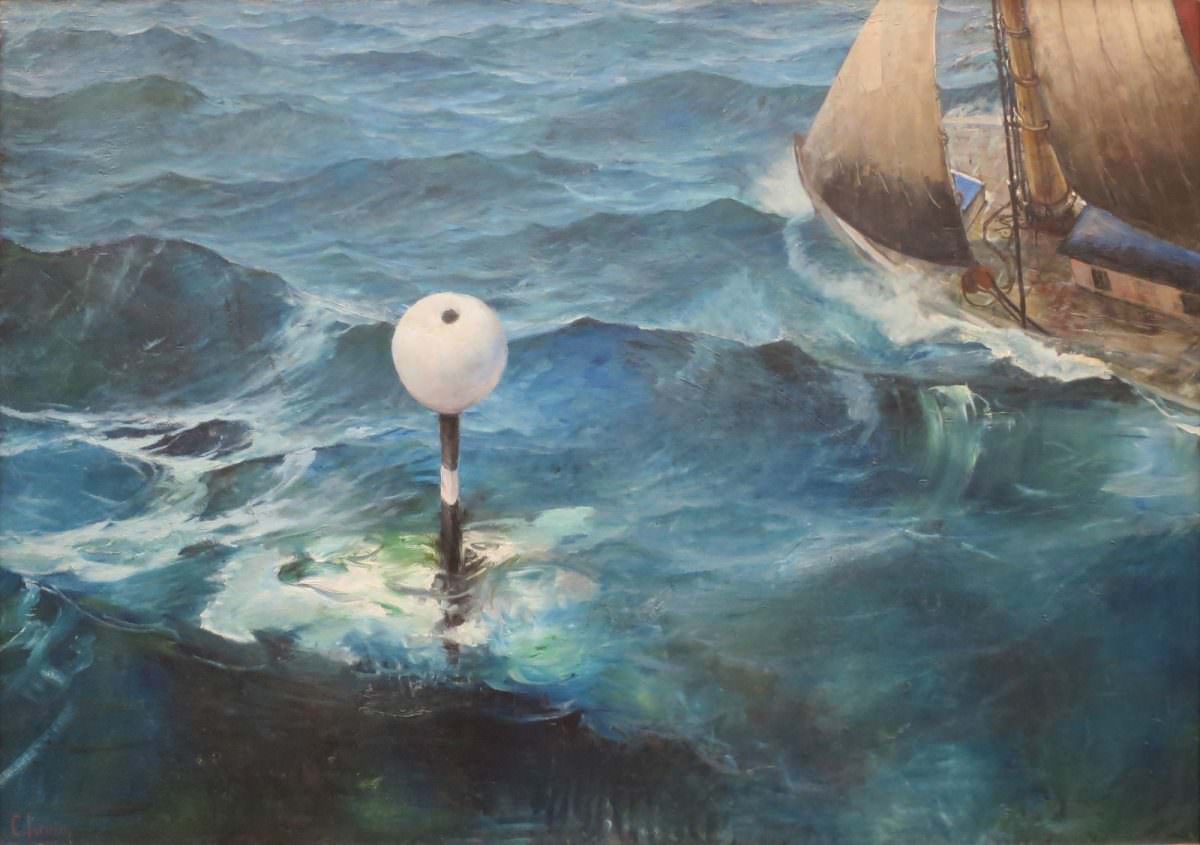
Salt water dominates the scene in “The Shoal, 1898,” rolling in heavy blue-green swells that feel close enough to spray the viewer. Near the center, a pale, spherical marker rises from the chop, its dark post striped like a warning, while the sea foams and brightens where waves break over shallow ground. At the right edge, part of a small sailing vessel appears—mast, rigging, and taut canvas—caught mid-passage as it skirts the hazard.
A shoal is less a place than a condition: hidden shallows that turn open water into a test of judgment and nerve. The buoy becomes the quiet protagonist here, signaling a boundary between safe depth and treacherous rise, and the painterly treatment of the water emphasizes movement, cold light, and uncertainty. Even without a visible shoreline, the work reads as maritime navigation distilled into one tense moment.
For readers interested in nineteenth-century seascapes and coastal artworks, this image offers a strong study in texture and atmosphere, balancing human craft against the sea’s constant rearranging. The partial view of the boat keeps the focus on the water itself—its shifting color, its sudden whitened crests, and the way danger announces itself only at the last second. “The Shoal, 1898” fits neatly into themes of maritime history, sailing, and the enduring visual language of sea markers and safe passage.