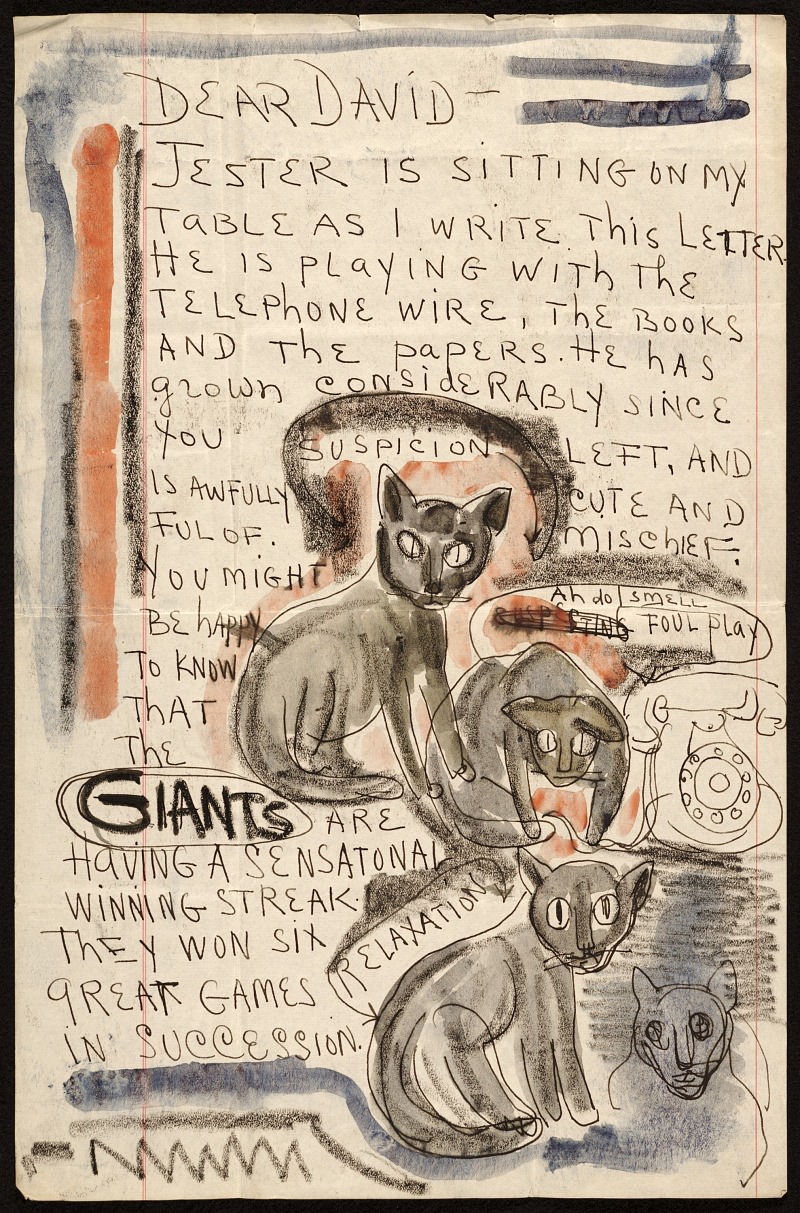
“Dear David—” opens a lively, handwritten page where Moses Soyer turns a simple letter into something closer to a sketchbook. The text sprawls in bold, uneven lines across paper marked by painterly washes and smudged tones, giving the note the immediacy of a studio table rather than a formal correspondence. Even without a visible envelope or postmark, the casual layout and intimate address place the viewer inside a family moment from the 1940s.
Cats prowl through the composition like characters in a small domestic drama, drawn with quick, confident strokes and wide, alert eyes. Soyer writes about “Jester” climbing onto the table as he works, and the animals seem to multiply in response—one sitting upright, another curling low, others hovering near the margins. A playful speech bubble adds humor, while the mix of ink-like linework and watercolor shading keeps the page balanced between illustration and personal memory.
Alongside the household scene, everyday references anchor the letter in its time: telephone wire, scattered books and papers, and a mention of the Giants’ winning streak. That blend of art, news, and affectionate observation makes this piece more than “Artworks”—it’s a window onto how an artist-parent narrated daily life to his son. For readers interested in Moses Soyer, David Soyer, and 1940s ephemera, the page offers both a tender message and a vivid example of how handwriting and drawing can merge into a single historical artifact.