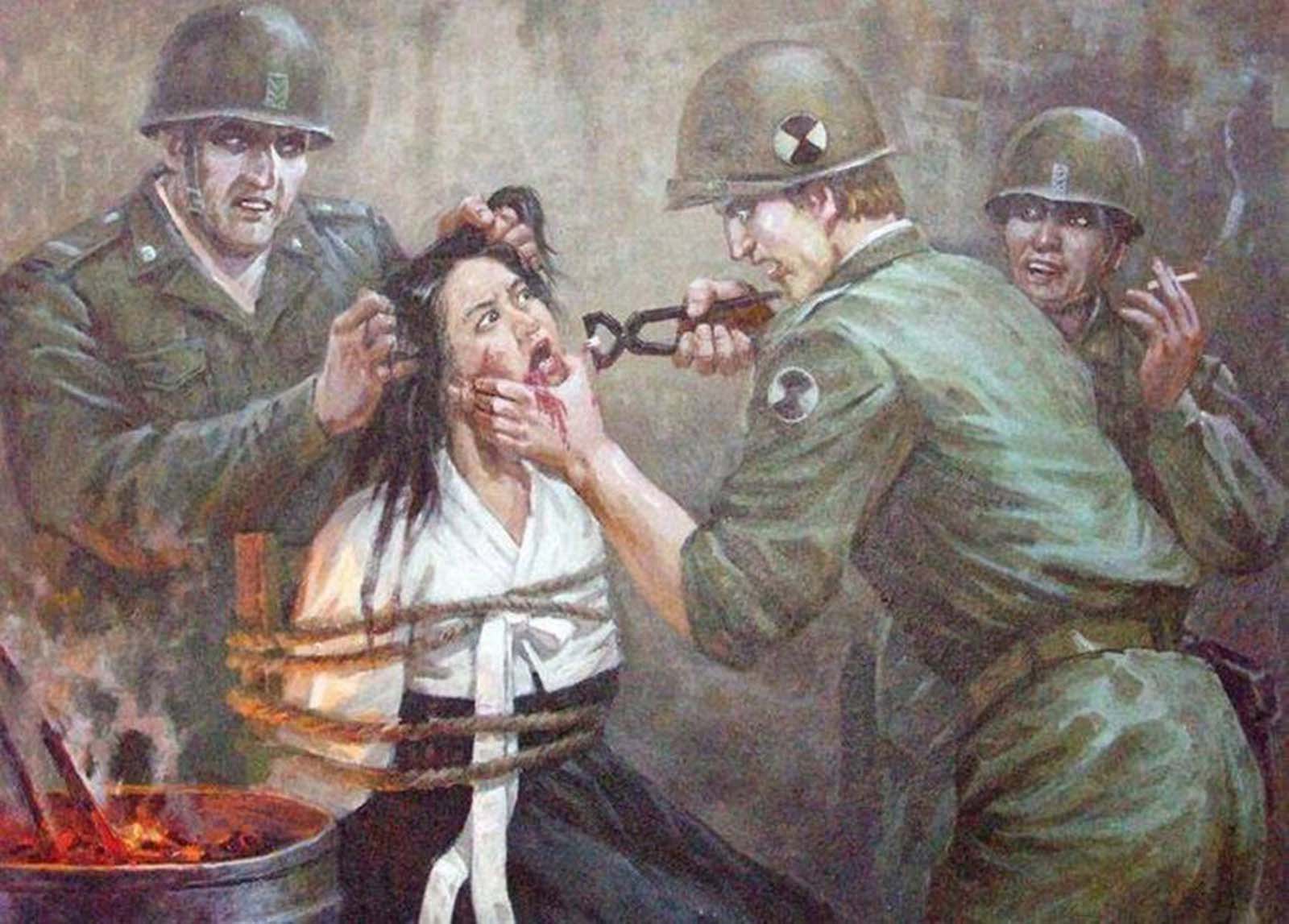
A harsh, staged-looking wartime artwork confronts the viewer with a bound Korean woman as uniformed soldiers crowd in, turning her terror into a spectacle. One man grips her face while another appears to use pliers at her mouth, and a third watches with a cigarette, as if violence has become routine. Coarse rope bites across her clothing and torso, and a brazier or barrel of burning coals glows at the edge of the scene, reinforcing the threat of torture.
The composition reads like propaganda illustration rather than a candid photograph, with exaggerated expressions and theatrical lighting that direct the eye to the act named in the post title: teeth being yanked out. Details such as helmets, patches, and the cramped interior setting evoke the Korean War era without clearly identifying a specific unit or place. Whether created as accusation, warning, or shock journalism, the image leans on graphic humiliation to tell its story.
For readers searching the history of war crimes imagery, Korea conflict propaganda, or depictions of torture in Cold War visual culture, this post offers a difficult but important artifact to examine. It raises questions about who produced such scenes, how they circulated, and how suffering—especially women’s suffering—was used to persuade audiences. Viewing it today demands care: not only to document what the artwork tries to communicate, but also to remember the real human cost behind violence rendered for impact.