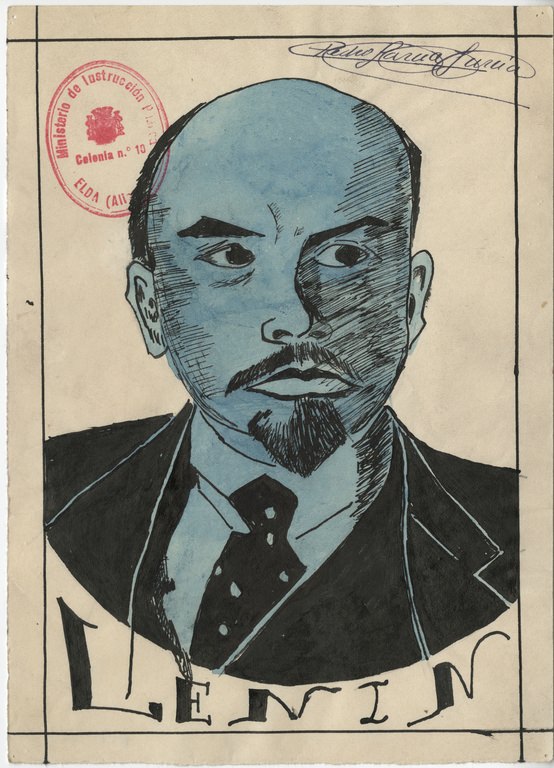
Bold ink lines and a cool blue wash shape a striking portrait labeled “Lenin,” rendered with graphic clarity and a poster-like intensity. The face is simplified into confident contours—arched brows, a sharp gaze, and the familiar goatee—while the suit and tie anchor the figure in a formal, almost emblematic pose. More than a straightforward likeness, the drawing reads like an artwork meant to be seen and understood quickly, the kind of visual shorthand that travels easily from wall to wall.
From Elda (Alicante), the piece also carries the tangible marks of circulation: a red institutional stamp at the upper left and a handwritten signature at the top right. Those details hint at a bureaucratic or educational context, suggesting the portrait lived within folders, classrooms, or local collections rather than only in private hands. The combination of official markings and expressive illustration gives it the feel of a document that is both art and artifact.
Set against the post title “Elda (Alicante). Lenin. Pedro García García,” this image becomes a window into how international political symbols were reproduced and reinterpreted in Spanish settings. Readers interested in Elda history, Alicante cultural heritage, and political iconography will find plenty to linger over in the linework, typography, and the stamped provenance. As an example of twentieth-century visual culture, it invites questions about authorship, purpose, and the everyday pathways through which ideology and design intersected.