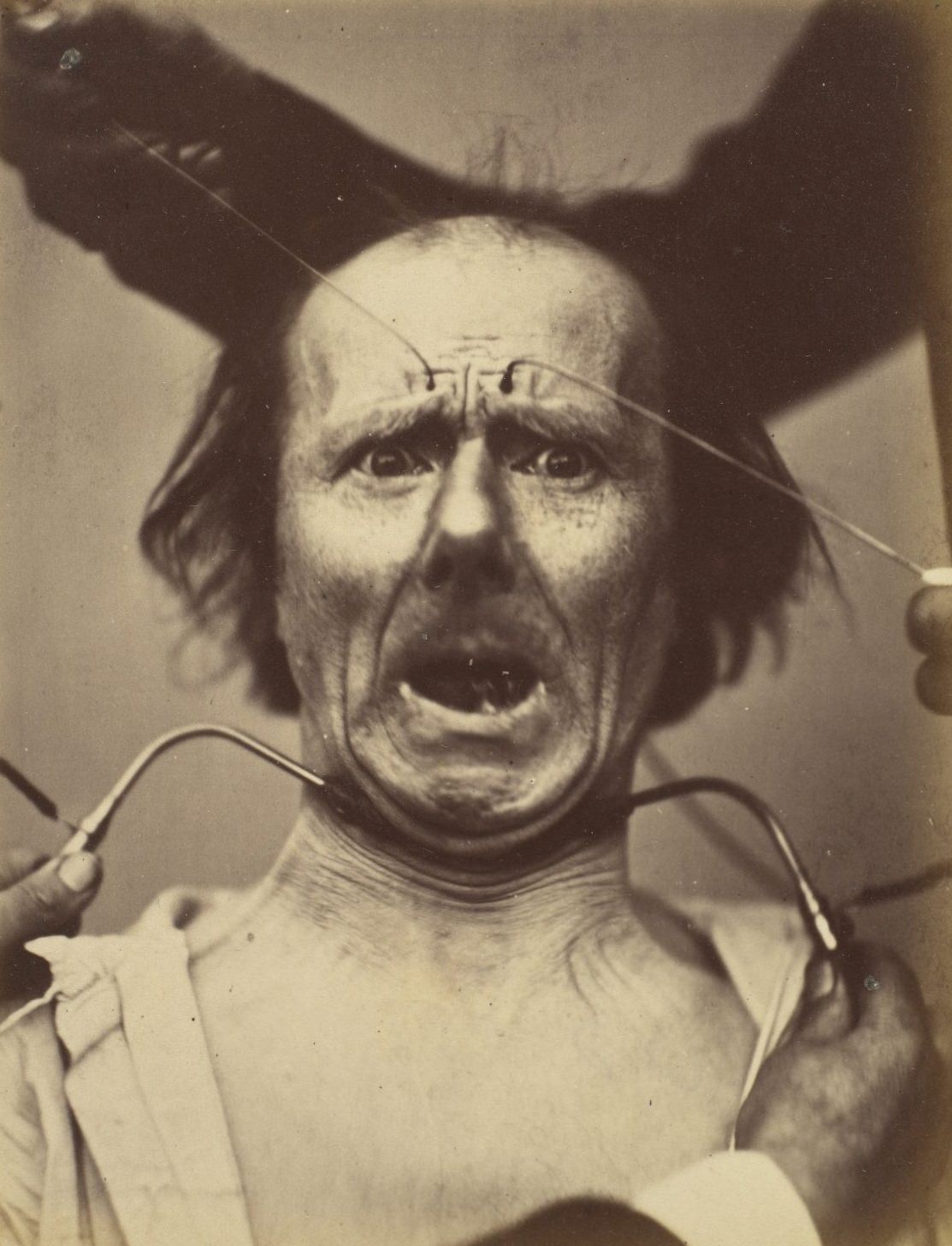
A single face dominates the frame, jaw dropped in a strained cry while thin wires and hooked instruments tug at the skin around the mouth and brow. The stark, studio-like backdrop offers no comfort or context, forcing attention onto every crease, tremor, and glint of tension. Even without a caption, the scene reads as an experiment—part performance, part procedure—where emotion is treated as something that can be pulled into view.
The title, “Icono-photographique. Mécanisme de la Physionomie Humaine,” points toward a period when photographers and researchers tried to map the human visage like machinery, reducing feelings to measurable movements. Here, the camera becomes a tool of analysis, recording an exaggerated expression as if it were evidence rather than experience. That uneasy mix of art and early visual science is precisely what makes the photograph so arresting today.
For collectors, historians, and readers searching for early photographic studies of expression, this artwork sits at the crossroads of anatomy, psychology, and the history of portraiture. The image invites questions about consent, spectacle, and the urge to classify what is most human—grief, fear, pain—through mechanical means. As a WordPress post feature, it offers a haunting entry point into discussions of historic photo experiments, physiognomy, and the changing ethics of looking.