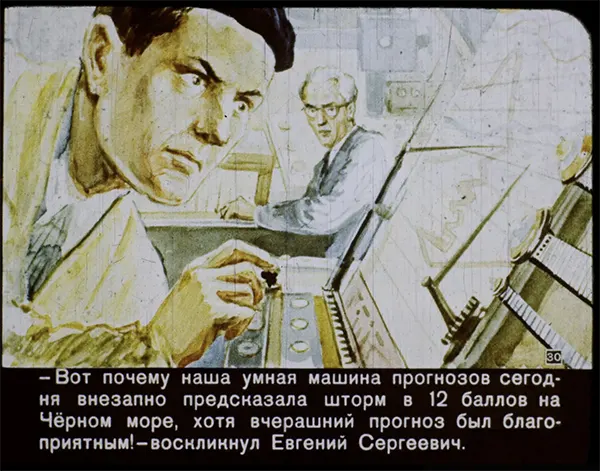
A stern engineer dominates the foreground, pen poised over a control panel, while an older colleague turns from a desk as if caught mid-discussion. The scene is rendered in that unmistakable mid-century Soviet illustration style—muted colors, sharp facial angles, and an atmosphere of purposeful urgency—inviting the viewer into a world where prediction, planning, and human judgment collide. Along the bottom runs a Russian caption, grounding the artwork in its original printed context and hinting at a narrative beyond the frame.
What makes these 1960s visions of “life in 2017” so compelling isn’t polished futurism, but the confidence that complex systems could be mastered from a room full of dials and switches. The artists imagine tomorrow through the tools of their own present: calculating machines, technical workstations, and specialists whose authority comes from training and discipline rather than sleek consumer tech. Even the implied drama—an unexpectedly severe storm forecast—turns the future into a story about responsibility and the limits of automation.
Viewed today, the illustration doubles as a time capsule of Soviet hopes and anxieties about forecasting, cybernetics, and scientific progress. For readers exploring retro future art, Cold War-era graphic design, and Soviet visions of the future, this post gathers the texture of that era: the human faces behind the “smart machine,” the institutional setting, and the idea that 2017 would be shaped by people who could outthink uncertainty. It’s a reminder that every imagined future is also a portrait of its own time.