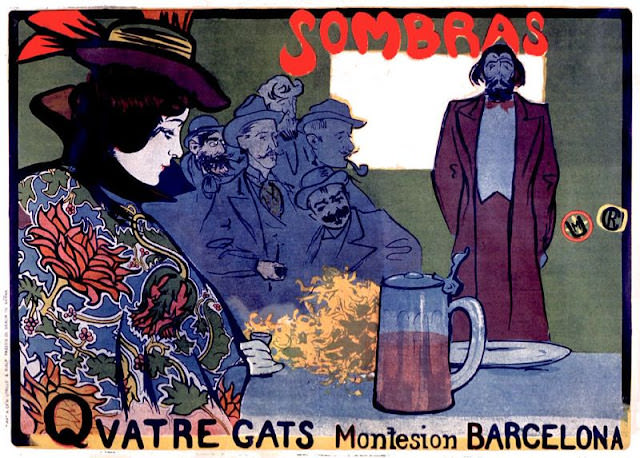
Sombras blazes across the top of this bold poster, immediately pulling the eye into the smoky, theatrical world associated with Quatre Gats in Barcelona. A stylish woman in a wide-brimmed hat dominates the foreground, her patterned shawl rendered in rich, decorative color that feels at once fashionable and symbolic. Behind her, a cluster of men sketched in cool, shadowy tones leans together like an audience or jury, their faces half-lost in the haze of conversation.
On the right, a solitary figure stands in a long coat as if about to deliver a monologue, turning the café interior into a stage. The tabletop details—a hefty glass mug and a spare plate—anchor the scene in everyday social ritual, while the swirling burst of warm color suggests lamplight, smoke, or the nervous energy of performance. The contrast between flat planes of color and expressive linework gives the artwork that late-19th-century poster snap, designed to catch attention from across a street or within a crowded room.
Quatre Gats (spelled out along the bottom with “Barcelona”) reads like both an address and an invitation, a reminder of how cafés became engines of modern art, satire, and nightlife. As a historical artwork, the image is less concerned with literal documentation than with atmosphere: elegance at the margin of mischief, public sociability threaded with private intrigue. For readers searching for Sombras, Quatre Gats, Barcelona 1897, this piece offers a vivid window into the graphic language that helped define an era’s cultural identity.