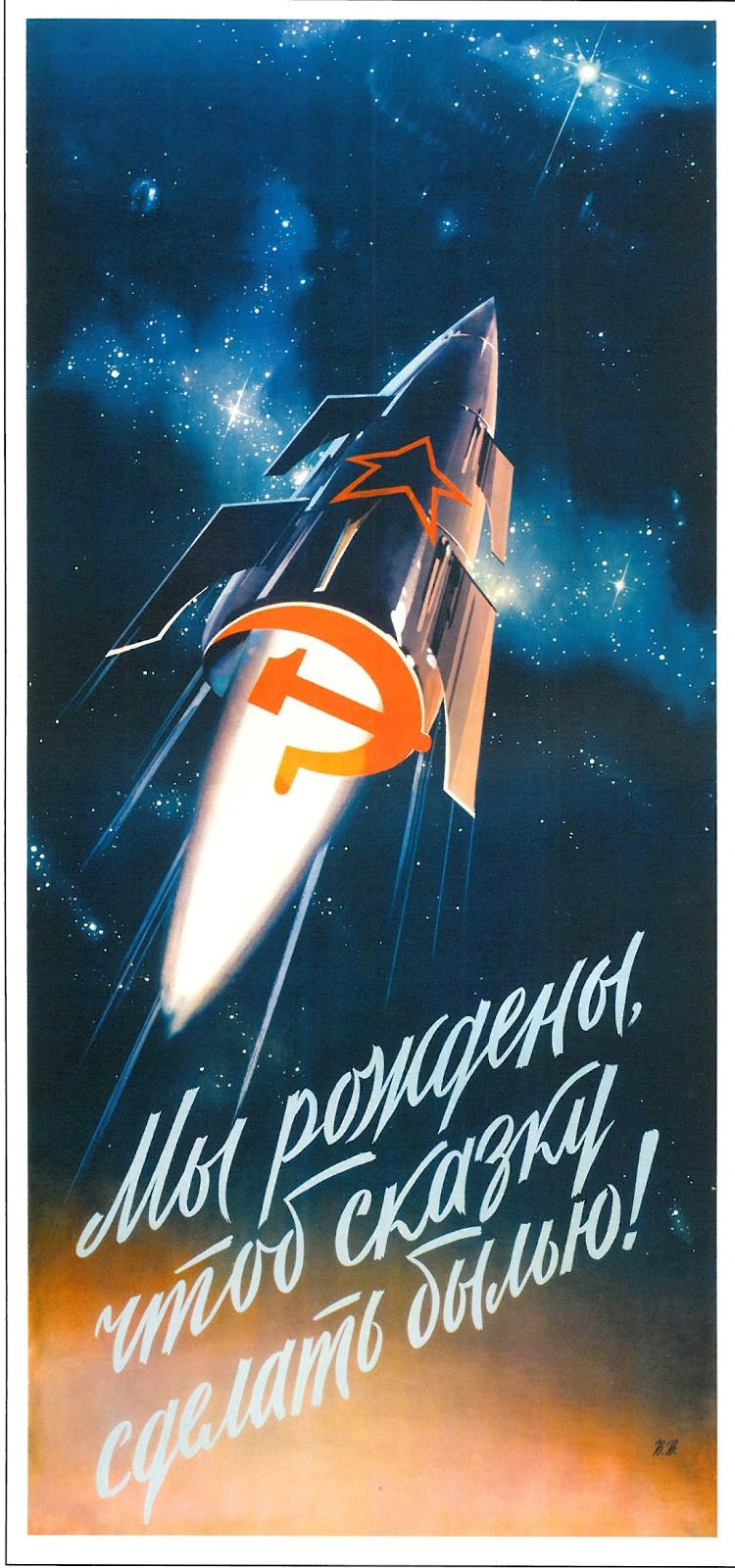
A rocket surges diagonally through a deep, star-sprinkled sky, its engine flare cutting a bright path that feels equal parts science and dream. The bold red star on the fuselage and the unmistakable hammer-and-sickle emblem turn the spacecraft into a symbol, not merely a machine—an announcement of ambition set against the limitless cosmos. Below, sweeping handwritten script amplifies the sense of motion, as if the message itself is racing after the craft.
The title, “We were born to make the fairy tale come true!”, lands like a manifesto of the Space Age, when posters and popular art worked hard to translate complex technology into everyday wonder. Here, the “fairy tale” is not castles and crowns but orbit and ignition, rendered in luminous blues and sharp highlights that celebrate modernity. As an artwork, it belongs to a tradition of propaganda and inspirational design that invited viewers to imagine themselves as participants in a grand collective future.
For anyone browsing historical posters, Soviet space-themed art, or retro sci‑fi aesthetics, this piece offers a vivid reminder of how hope was marketed in the language of stars. The composition directs the eye upward, pairing cosmic scenery with confident emblems and theatrical typography to create a simple story: progress is destiny, and the sky is only the beginning. Seen today, it reads both as period optimism and as a striking graphic artifact worth revisiting for its cultural history and visual power.