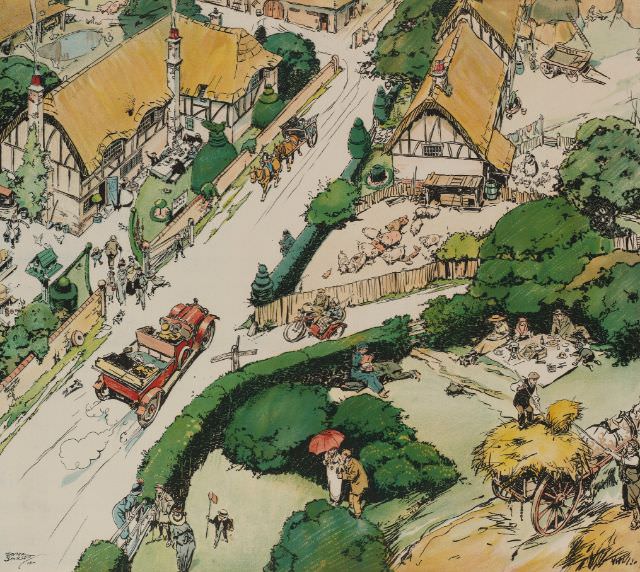
A bright country lane unspools between thatched cottages and clipped hedgerows, rendered with the lively linework and tinted washes associated with illustrated social scenes. A motorcar rattles past wagons and pedestrians, while a horse-drawn cart and neatly fenced gardens keep the village rooted in older rhythms. The title “In the Country,” from “Humours of London,” hints at a deliberate contrast—city sensibilities observing rural life with curiosity, affection, and a touch of satire.
Along the roadside, small incidents accumulate like punchlines: cyclists lean into the curve, a figure pauses under an umbrella, and villagers gather at gates as if the day’s passing traffic is entertainment in itself. The artist’s elevated viewpoint turns the road into a stage, letting the eye roam from chimneys and fences to the soft green of trees and shrubs. Details such as hay, livestock, and timbered buildings evoke a pastoral economy, even as modern transport intrudes with smoke, speed, and noise.
Seen today, the artwork reads as more than a charming countryside illustration; it’s a snapshot of social change, where tradition and modernity share the same bend in the road. For readers interested in British rural imagery, early motoring, and the visual humor of “Humours of London,” this piece rewards slow looking and repeated visits. Its storytelling energy makes it an ideal historical image for a WordPress post—rich in period atmosphere, everyday characters, and the quiet comedy of ordinary life.