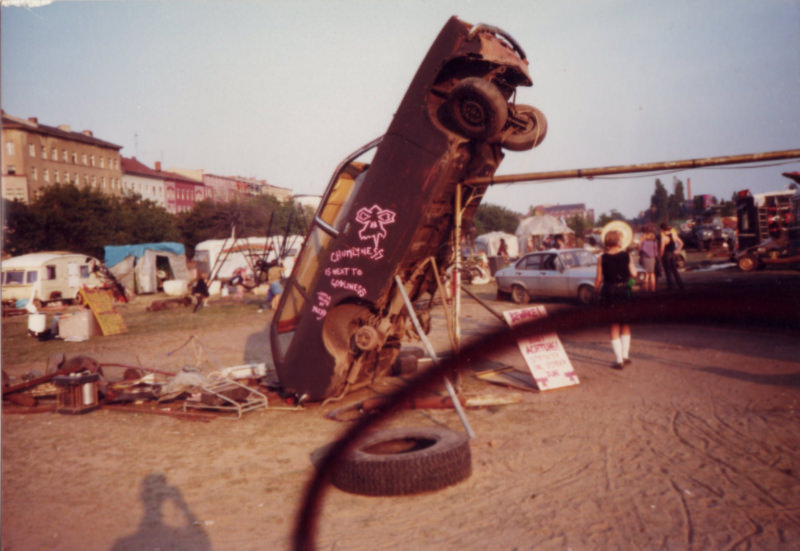
A battered car is hoisted upright like a totem, its undercarriage and wheels turned outward for all to see, transforming the familiar silhouette of a vehicle into something closer to a monument. In the dusty open lot around it, scattered scrap, tires, and makeshift equipment suggest a working environment as much as an exhibition—part yard, part stage. The painted markings on the bodywork hint at the hand of artists who treated metal panels as canvas, letting rust, dents, and welding seams become part of the composition.
Behind the centerpiece, a loose crowd moves through an improvised scene of vans, tents, and salvaged materials, evoking the itinerant energy associated with the Mutoid Waste Company’s 1980s ethos. The whole arrangement speaks to the era’s DIY art culture, when industrial leftovers were refashioned into provocative sculpture and public spectacle. Rather than hiding the origins of the parts, the display leans into them, using the language of scrap cars and broken machinery to build a new kind of street-level artwork.
Viewed today, the photograph reads as a vivid document of upcycled art before “recycling” became a mainstream creative slogan, capturing the raw appeal of car-scrap sculpture and junkyard installation. It also underlines why the Mutoid Waste Company remains a touchstone for fans of industrial art, alternative performance, and post-punk visual culture—where disruption was the point and beauty could be welded together from wreckage. For readers exploring bizarre artworks from scrapped cars, this scene offers a grounded glimpse of how such pieces lived in real spaces, among real people, amid the grit and freedom that shaped them.