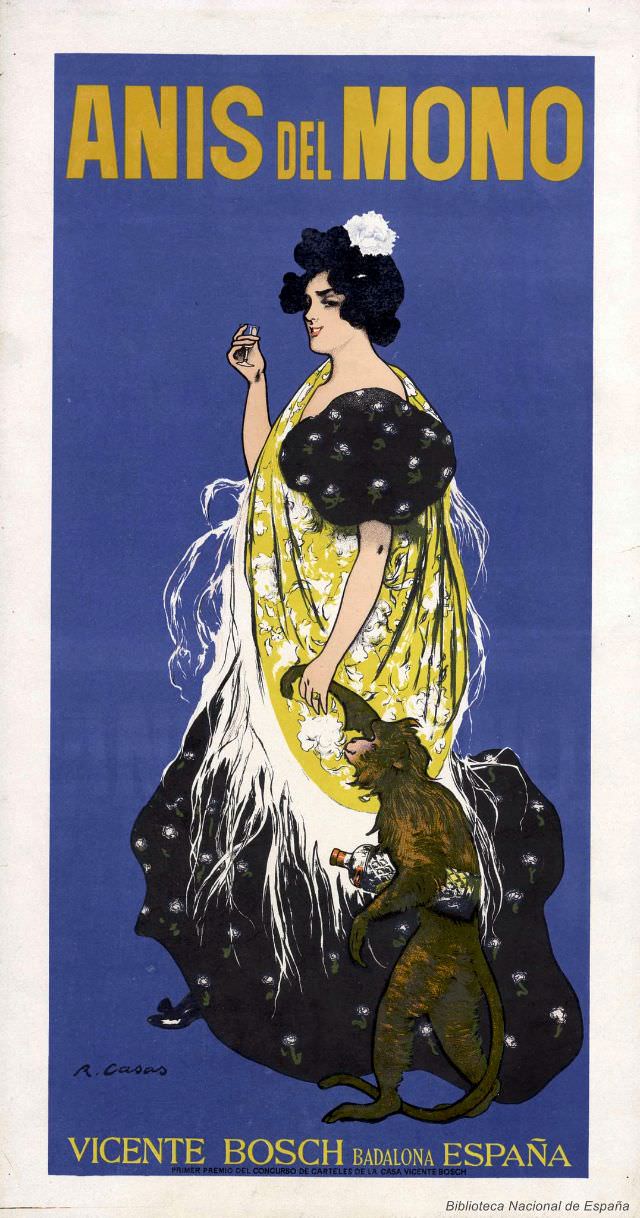
Bold gold lettering announces “ANÍS DEL MONO” across a deep blue field, framing a glamorous figure rendered in the elegant, simplified curves associated with late‑19th‑century poster art. Draped in a flowing yellow-and-black gown with long white fringe and a flower tucked into dark hair, she raises a small glass as if inviting the viewer into a moment of leisure. The composition uses broad areas of flat color and striking contrast to make the brand name instantly readable—classic advertising design turned into collectible artwork.
At her feet, a monkey becomes the witty emblem of the drink, posed with a bottle in hand and echoing the product’s famous identity without needing a busy scene or detailed backdrop. The playful pairing of sophistication and satire—fashionable woman above, mischievous mascot below—turns a simple liquor advertisement into a memorable narrative. Even today, the image works as a lesson in how early commercial posters fused illustration, typography, and character branding to lodge a name in the public mind.
Dated 1898 in the post title, this Anís del Mono artwork also points to Spain’s vibrant print culture at the turn of the century, when companies invested in high-impact graphics to compete in crowded markets. The bottom text—“VICENTE BOSCH,” “BADALONA,” and “ESPAÑA”—anchors the piece to its maker and origin, reinforcing authenticity while doubling as promotion. For readers interested in vintage advertising, Spanish graphic design, and the history of spirits branding, this poster remains a vivid window into how commerce and art learned to speak the same language.