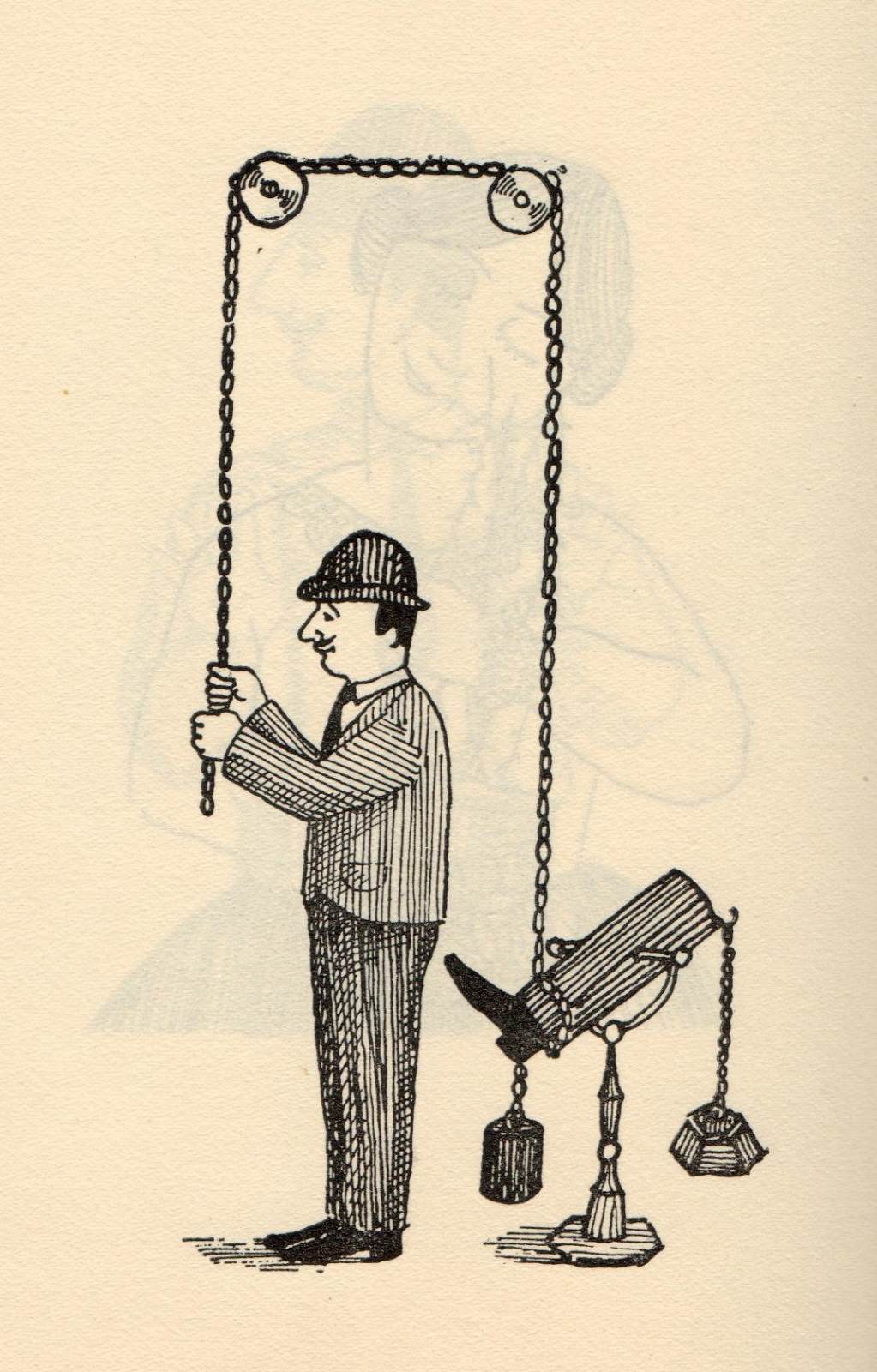
Roland Topor’s 1960 illustration distills masochism into a small, unsettling stage: a neatly dressed man stands beneath a loop of chain, hands fixed to the dangling links as if he has volunteered for his own restraint. The drawing’s sparse background and crisp ink lines leave nowhere for the eye to hide, forcing attention onto the quiet ritual of self-control, self-sabotage, and consent implied by the pose.
To the right, an angled contraption—part bench, part apparatus—sits tethered to the same chain system, weighted by a block and a faceted mass that suggest pulleys, balance, and inevitable pull. Topor’s wit lives in these mechanical details: the scene feels both clinical and absurd, as though pain has been converted into a piece of everyday engineering, operated with the same calm practicality as a tool in a workshop.
Viewed today, the artwork reads as a sharp example of mid-century satirical illustration, using minimalism to explore erotic psychology without explicitness. The tension between the man’s ordinary attire and the punitive geometry around him captures a broader theme in Topor’s masochism-themed art—how desire can be staged, managed, and even normalized through objects. For readers interested in Roland Topor, 1960 drawings, and the history of provocative illustration, this piece offers a compact but memorable descent into the mechanics of submission.