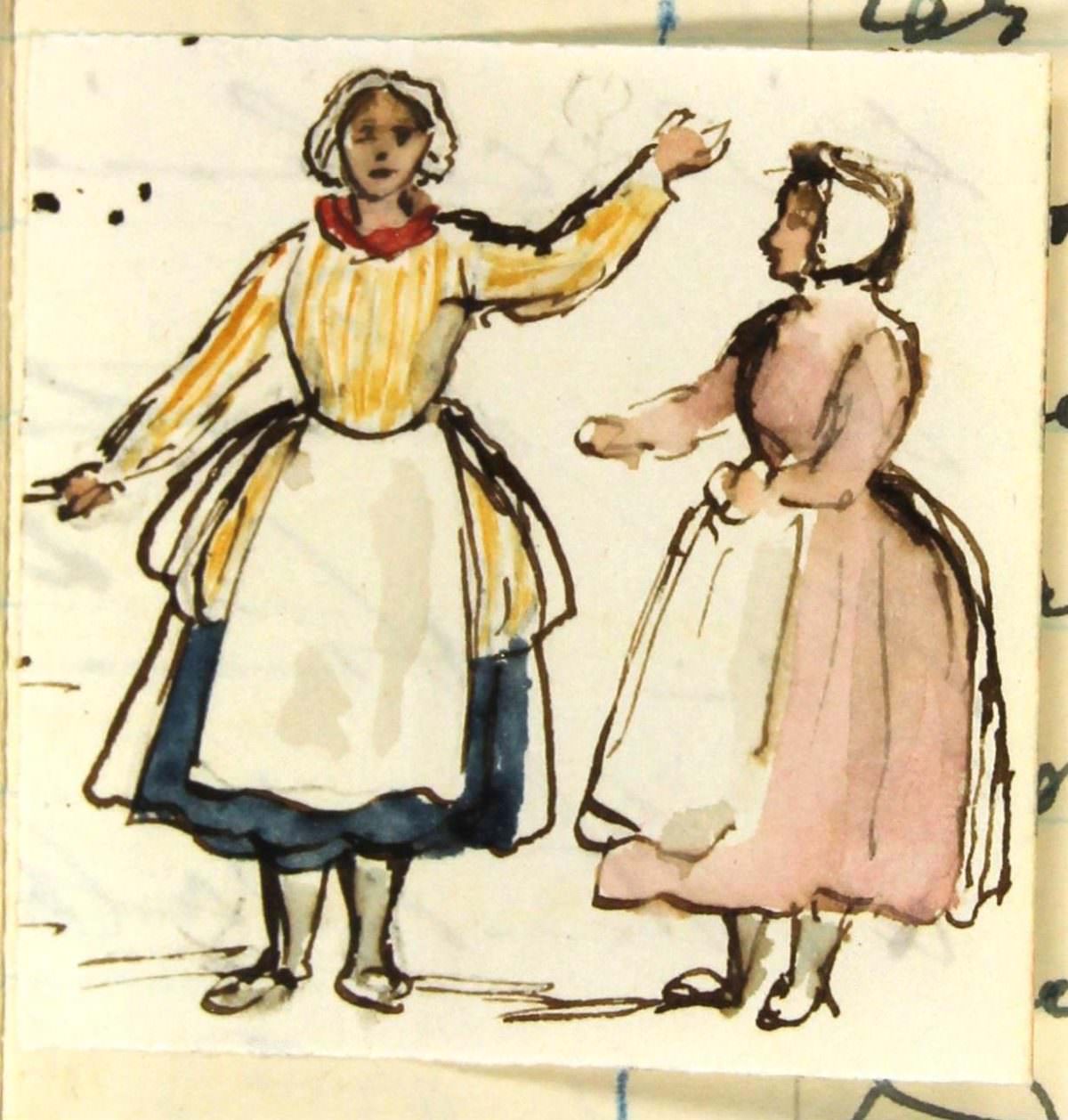
Loose, confident pen lines outline two Scottish fisherwomen as they stand in mid-gesture, their working clothes turned into a lively study with small washes of watercolour. One figure lifts an arm as if calling out or hailing someone just beyond the frame, while the other angles her body in reply, headscarf and apron sketched with quick certainty. The palette is spare but effective—warm ochres, soft pinks, and deep blue at the hem—giving the scene a sense of movement rather than polished finish.
Queen Victoria’s hand is visible in the directness of the drawing: faces simplified, folds suggested, and silhouettes prioritised over tiny detail. That immediacy suits the subject, because fisherwomen’s dress was practical and distinctive, built for wind, salt air, and long hours of labour and trade. Even without a named shoreline or harbour in view, the visual language of apron, shawl, and sturdy shoes anchors the piece firmly in everyday coastal life.
Dated in the title to Saturday 3rd September 1842, this small artwork sits at an intriguing crossroads of royal travel, personal observation, and nineteenth-century social history. For readers searching for Scottish fisherwomen art, Queen Victoria sketches, or Victorian pen and ink drawings with watercolour, it offers a close look at how working people could enter the royal sketchbook—briefly, candidly, and with surprising empathy. The result feels less like a staged scene and more like a moment caught on the wing, preserved in ink and colour.