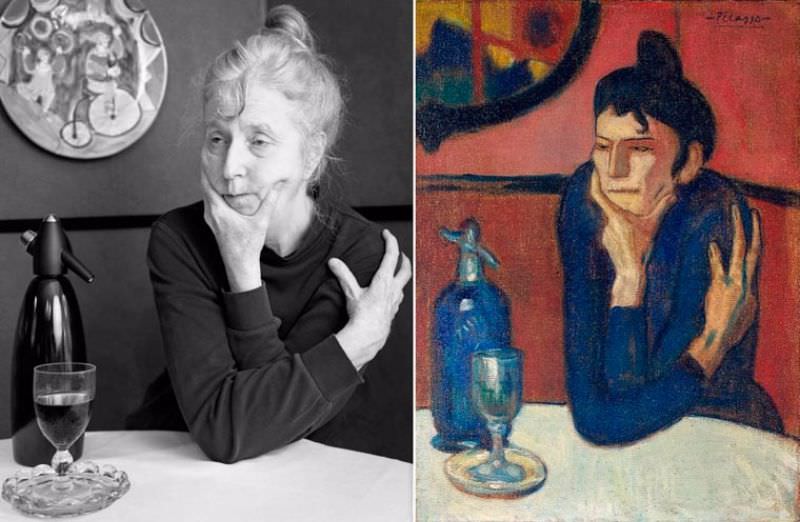
A quiet table scene anchors “Absinthe Drinker – Pablo Picasso,” pairing a candid photograph with the painter’s own interpretation of the same weary pose. On one side, a sitter rests her chin in her hand, the other arm folded close as if bracing against the room; on the other, Picasso translates that posture into broad, moody color and simplified form. The still life details—carafe, glass, and tabletop—become stage props for an inner life that feels heavier than the setting.
What lingers is the contrast between documentary realism and artistic reinvention: the photo’s soft tonal range versus the painting’s charged reds and blues, the natural folds of clothing versus Picasso’s sculpted planes. Even without a named location or date, the pairing evokes café culture and the long shadow absinthe cast in modern art, where a drink could signify distraction, melancholy, or modernity itself. The repeated gesture of the hand-to-face pose reads as both boredom and contemplation, inviting viewers to decide where the figure’s mind has wandered.
For readers exploring Picasso artworks, this post offers a compelling way to see process through comparison—how an everyday moment can be edited into visual psychology. Searchers looking for “Absinthe Drinker Picasso” will recognize the iconic bottle-and-glass motif, but the accompanying photograph adds texture to the story, grounding the painting’s stylization in lived presence. Spend a moment with the two halves together, and the scene becomes less about the drink and more about the enduring human posture of waiting, thinking, and enduring.