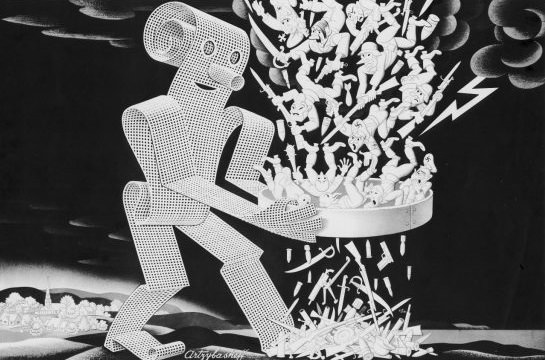
A towering, stylized figure built from dotted tones bends over a wide cauldron, as if tending a furious boil. From the pot erupts a storm of jagged shapes—shards, bolts, and splintered forms—shooting upward in a chaotic plume, while the surrounding darkness makes the blast of white marks feel even more violent. The composition has the punch of wartime propaganda, mixing humor, menace, and mechanical energy in a way that draws the eye straight into the turmoil.
Boris Artzybasheff’s anti-Nazi illustration work during World War II often relied on exaggeration and metaphor rather than literal battlefield scenes, and the visual language here makes that clear. The cartoonish anatomy and industrial textures suggest a world where ideology becomes machinery, churning and spewing debris, while the sharp diagonals and repeated fragments give the sense of relentless motion. It’s an arresting example of WWII art using surreal caricature to undermine authoritarian power and turn it into something grotesque and unstable.
For readers interested in Artzybasheff illustrations, this post highlights how creative graphic design served as a cultural weapon during the Second World War. The stark black-and-white contrast, the dense patterning, and the explosive symbolic action create an instantly memorable anti-Nazi message without needing captions to explain it. As a piece of historical wartime artwork, it offers a vivid window into how artists helped shape public perception through satire, symbolism, and bold visual storytelling.