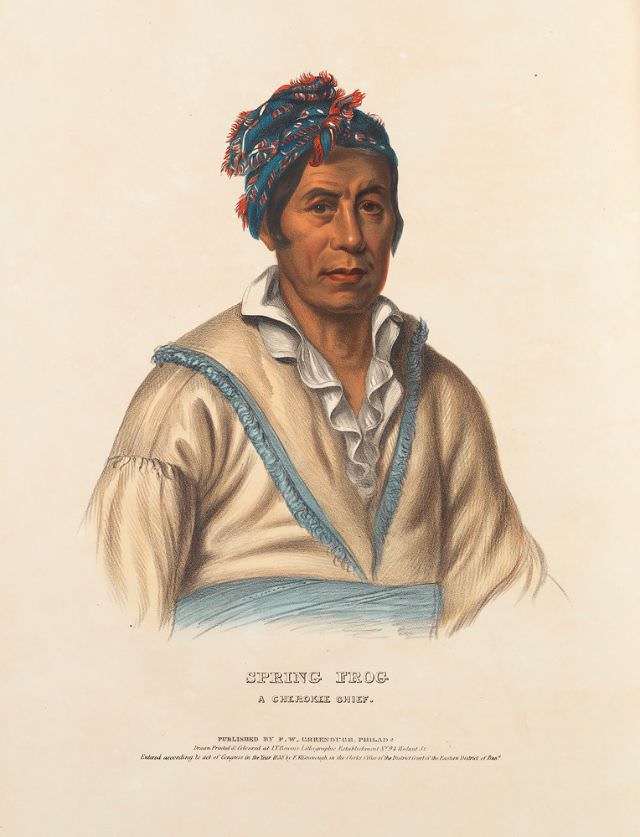
Spring Frog is presented in a formal, carefully posed portrait that centers on dignity and presence rather than spectacle. His steady gaze meets the viewer, while a patterned headwrap with red accents and a pale garment trimmed in blue draw the eye to texture and workmanship. The inscription beneath—“SPRING FROG, A CHEROKEE CHIEF.”—frames the subject in the language of the print itself, inviting readers to consider how identity and authority were communicated to audiences through published art.
Clothing details carry much of the story here: a ruffled white shirt at the collar, soft folds in the fabric, and a sash-like band at the waist suggest a deliberate blend of personal style and the conventions of portraiture. The neutral background keeps attention on expression and attire, a common approach in historical prints meant for wide circulation. As an artwork, it offers a window into how Indigenous leaders were represented and consumed as images in an era when portraits often stood in for firsthand encounters.
Viewed today, this piece functions as both historical record and constructed narrative, shaped by the artist’s choices and the expectations of the market for “Indian portraits.” For readers searching for Cherokee history, Native American portrait art, or early American prints, the image provides rich visual evidence—while also raising questions about translation, labeling, and the limits of what a single portrait can tell. In that tension between intimacy and distance, “Spring Frog, A Cherokee Chief” remains a compelling artifact for study and reflection.