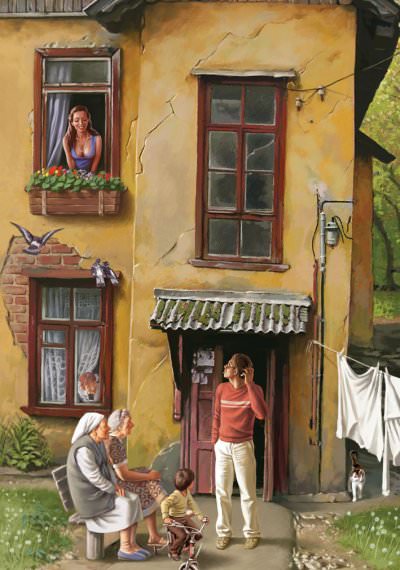
“Bad date” sets a quietly comic scene on the worn façade of an old house, where everyday life spills out into the yard. Sun-faded plaster, a patch of exposed brick, and uneven window frames give the building a lived-in character, while flower boxes and lace curtains hint at careful pride beneath the cracks. Up above, a woman leans from an open window, watching the small drama below with the ease of someone who knows the neighborhood rhythms.
At ground level, the story tightens around a doorway shaded by a little awning, where a tense conversation seems to be unfolding. An older pair sits together like patient witnesses, a child hovers at their feet, and a standing figure gestures with the exasperation of someone explaining—again—how the evening went wrong. Details in the corner—laundry on a line, a small animal near the wall, a glimpse of grass and garden—anchor the moment in domestic reality, making the title’s promise of romantic mishap feel even more ironic.
As an artwork with a historical-photo sensibility, the piece leans on texture and observation rather than spectacle, inviting you to read expressions and body language like clues. The setting evokes working-class home life, communal courtyards, and the way private disappointments become public stories when windows are open and neighbors are close. For readers searching for vintage street life, nostalgic family scenes, or narrative art that feels like a memory, “Bad date” offers a richly detailed glimpse into ordinary people and the small turning points that make a day unforgettable.