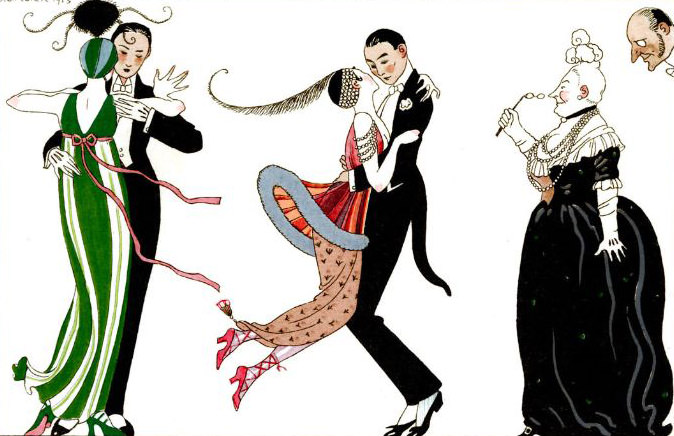
La Folie du Jour, 1913, reads like a wink from the early twentieth century—an illustrated snapshot of nightlife where elegance and satire share the same dance floor. Slender figures in formal dress glide and pivot against a stark white backdrop, their elongated limbs and angled poses turning motion into graphic design. The limited palette—inky blacks, crisp whites, and sharp touches of green and red—gives the scene a fashionable, poster-like punch that feels both theatrical and modern.
At the center, a couple spins with exaggerated grace: the dancer’s sweeping hat brim, patterned stockings, and ribboned shoes suggest costume as much as couture, while her partner’s tailored black suit anchors the swirl. To the left, another pair leans into a close embrace, the vertical stripes of a dress cutting a bold line that echoes the period’s love of striking silhouettes. Every curve and flourish—down to the floating ribbons—amplifies the sense of “folie,” a playful excess that fits the title perfectly.
On the right, a larger, richly dressed figure observes the scene with a cigarette held aloft, adding a note of social commentary and a hint of backstage judgment. The drawing’s caricatured faces and poised gestures evoke the world of cabarets, salons, and stage entertainment, where style could be as performative as the dancing itself. For readers searching for 1913 art, Belle Époque illustration, or vintage French graphic design, this artwork offers a lively doorway into the era’s humor, fashion, and restless energy.