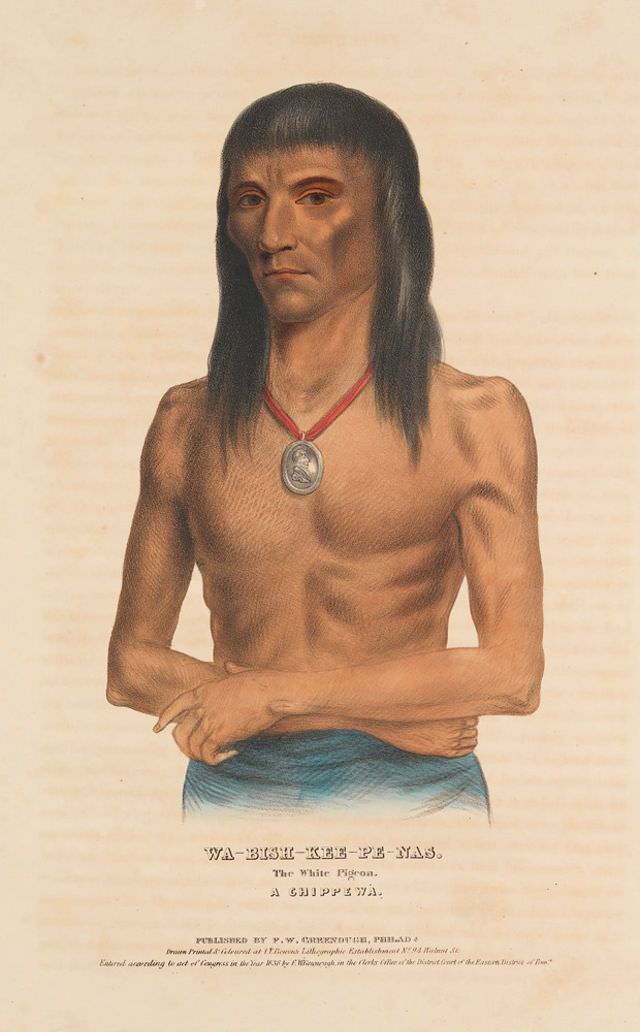
Wa-Bish-Kee-Pe-Nas—translated here as “The White Pigeon”—is presented in a carefully rendered portrait that reads like a published print rather than a candid scene. The figure stands frontally with a steady, unsmiling gaze, long straight hair falling to the shoulders, and arms folded in a guarded, composed posture. A small oval medallion hangs at the chest on a red cord, a detail that draws the eye and hints at the complex exchanges of the period in which many Indigenous sitters were depicted for non-Native audiences.
Subtle color and fine linework give the skin, musculature, and facial features a sculpted clarity, while the plain background keeps attention fixed on the subject’s presence. The clothing is minimal, with a blue cloth at the waist, and the overall composition feels designed to catalog identity through recognizable markers—hair, pose, adornment—rather than through setting or narrative. Beneath the image, the printed caption reinforces the sitter’s name and Chippewa affiliation, framing the portrait as both artwork and document.
For readers searching for historical Native American portraits, Chippewa artwork, or early printed representations of Indigenous leaders, this piece offers a striking example of how identity was mediated through illustration and publication. At the same time, the directness of the gaze resists easy consumption, inviting viewers to consider the person behind the label and the circumstances under which such images circulated. As an “Artworks” entry, it serves as a valuable visual record and a prompt to read titles, translations, and captions with care.