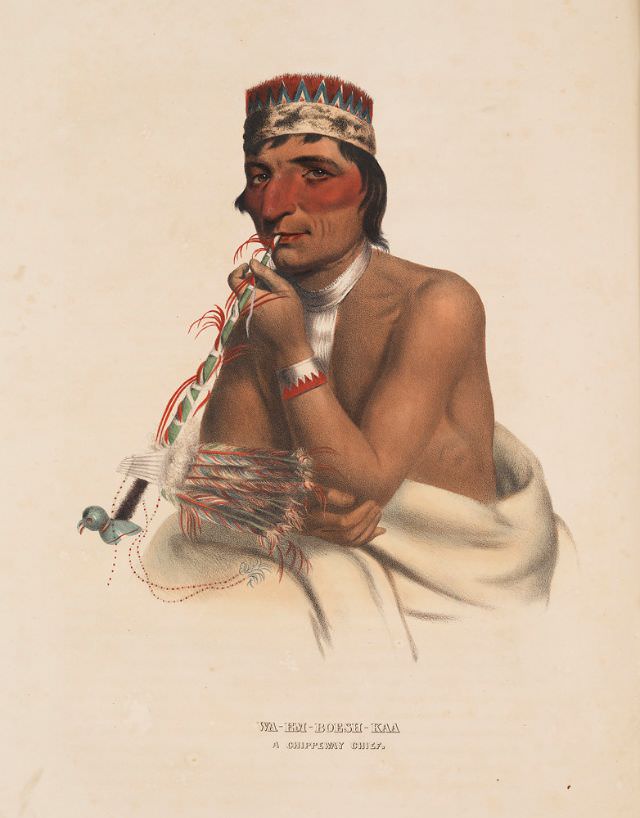
Wa-Em-Boesh-Kaa is presented in a carefully staged portrait that emphasizes presence over spectacle, drawing the viewer first to his steady gaze and then to the crisp detail of his dress. A patterned headband with red and blue accents frames his face, while a light wrap falls across his shoulders and torso, leaving the composition uncluttered and focused. The artist’s soft shading and warm tones lend the work an almost intimate quiet, as if the sitter has paused mid-thought.
Close attention to adornment reveals a world of meaning: the beaded band at the wrist, the layered feathers, and the small bird-like ornament near his arm create a visual vocabulary of status and identity. The long, decorated pipe held near his lips anchors the scene, its ribbons and quillwork-like textures rendered with particular care. Rather than treating these elements as mere decoration, the portrait invites readers to consider how materials, patterns, and ceremonial objects communicated leadership and community ties.
As an artwork, this image sits within a larger tradition of nineteenth-century representations of Indigenous leaders, shaped by the tastes and expectations of distant audiences. The title, “Wa-Em-Boesh-Kaa, A Chippeway Chief,” offers a starting point for research while also reminding us to read such portraits critically—asking who commissioned them, how they circulated, and what they leave unsaid. For anyone exploring Chippewa history, Native American portraiture, or early American print culture, this piece offers a striking example of how art can preserve likeness while filtering it through its own era’s lens.