Category: Artworks
Step into the world of timeless artworks that shaped our visual culture. Explore rare paintings, sculptures, and creative masterpieces that reveal the evolution of artistic expression through centuries.From Renaissance genius to modern minimalism, each piece tells a story of imagination, innovation, and beauty that continues to inspire artists and collectors worldwide.
-

#39 V. Viktorov. Creative resources of Socialism are boundless 1959.
Bold Cyrillic lettering shouts across a deep, star-speckled sky: “Творческие силы социализма — беспредельны!” (“The creative forces of socialism are boundless!”). Against that cosmic backdrop, a metallic satellite-like craft arcs past a cratered planet, its polished surfaces catching light as if freshly launched into the Space Age. The palette—electric blues, bright whites, and urgent red-orange…
-

#1 Do not lose your working minutes! 2
Bright propaganda-style artwork turns an outdoor break into a pointed lesson about time and discipline: a smiling woman in a yellow dress sits amid tall grass and wildflowers while uniformed men crowd around her, offering attention and small bouquets. Their relaxed poses and playful expressions contrast with the military hardware nearby, including a large piece…
-

#17 Do not be late for production!
Bold Cyrillic lettering commands attention with a clear workplace message—“Do not be late for production!”—while the scene below turns that warning into a small drama. A worker in cap and overalls is locked in an embrace with a woman in a bright polka-dot dress, their kiss filling the foreground as if time has momentarily stopped.…
-

#33 Miracle Stewpan
Bright kitchen light and a burst of mid-century optimism set the scene as a smiling home cook lifts the lid on a gleaming pan, revealing a perfectly arranged roast surrounded by colorful vegetables. Around the crowded table, faces turn with anticipation—children leaning in, an older relative smiling approvingly, and a neighborly onlooker at the edge…
-
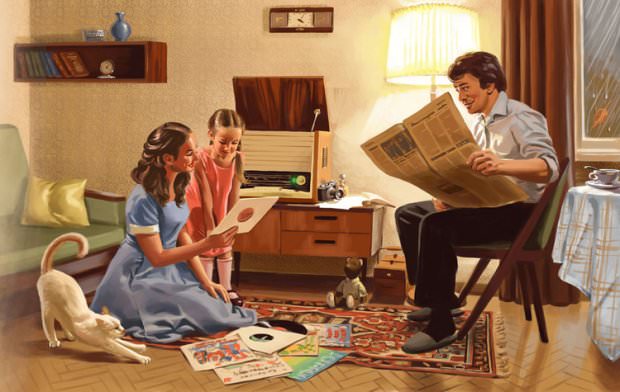
#49 Radiola
Radiola sets the scene in a cozy mid-century living room where the radio cabinet holds pride of place, its dial glowing like a tiny stage. A woman and a child kneel on the floor with records and sleeves spread across a patterned rug, suggesting the ritual of choosing what to play next. Nearby, a curious…
-
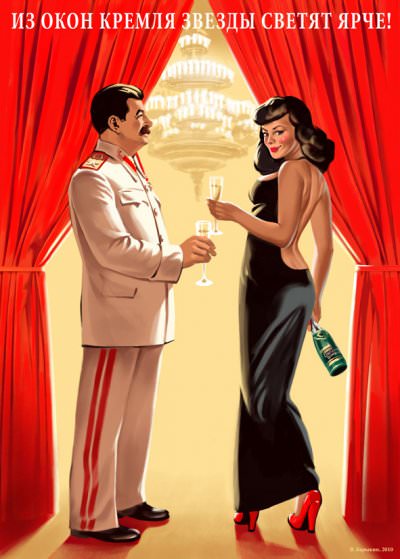
#65 Stalin and Betty
Under heavy red curtains, a uniformed Soviet figure with Stalin’s familiar moustache faces a glamorous woman in a sleek black evening gown, the pair poised mid-toast with champagne flutes. Behind them, a softly rendered Kremlin-like silhouette and the bold Cyrillic slogan across the top push the scene into the realm of propaganda-meets-pin‑up, where political iconography…
-
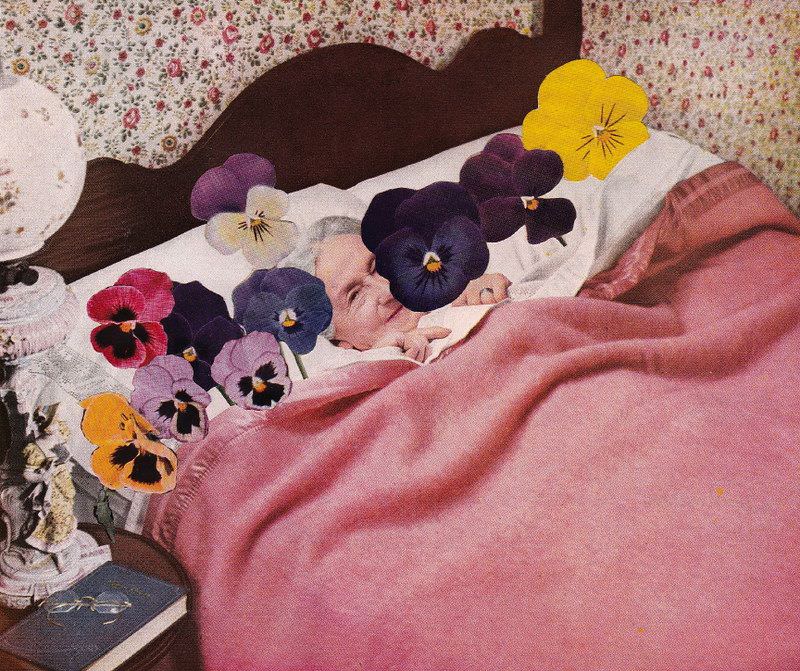
#6 Aging flower child
Soft floral wallpaper and a dark wooden headboard frame a quiet bed scene, where an elderly figure rests beneath a rose-toned blanket. Oversized pansy blooms—deep violet, buttery yellow, and inky blue—spill across the pillow and drift over the face like a dreamlike crown. The color palette feels deliberately tender, turning a private moment into a…
-

#22 It’s a fact- If Doris weighs 130 pounds on earth she would only weigh 21.5 pounds on the moon
Against a star-sprinkled sky, a poised woman in a pale, strapless wrap stands at the edge of a craggy lunar landscape, her gaze lowered as if feeling the strange pull of a different world. A bright, round Moon hangs nearby like a studio prop turned celestial anchor, while the rocky ridges behind her read as…
-
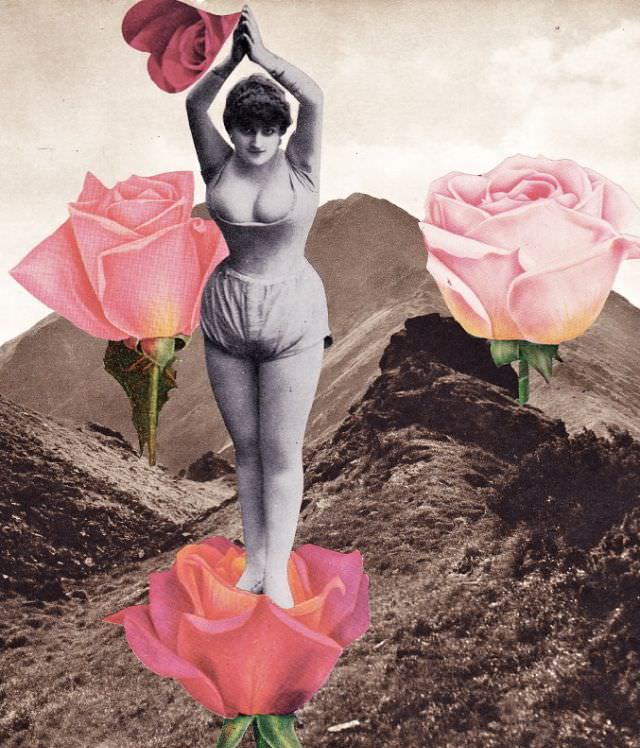
#38 Vivienne’s passion for roses invaded her dreams at night
Between rugged mountain ridges and a hazy sky, a woman stands in a poised, stage-like stance, arms lifted overhead as if caught mid-performance. The backdrop reads like an old landscape print, yet the scene is punctured by oversized roses in lush pinks and reds—blooms that feel more imagined than botanical. That collision of textures, scale,…
-
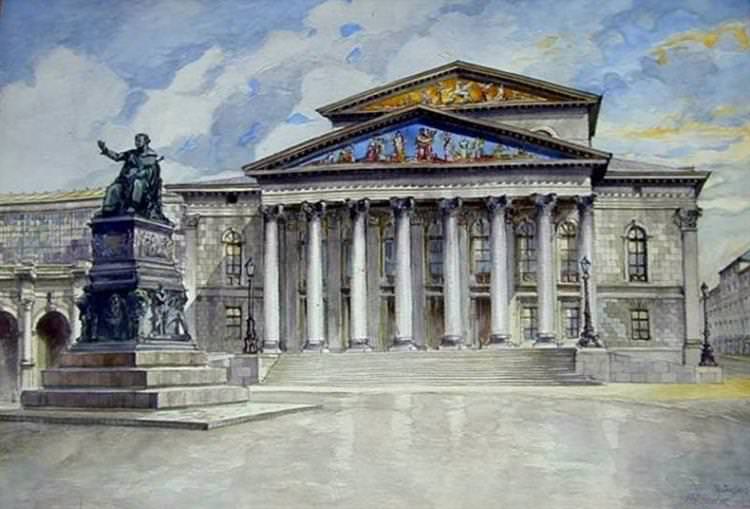
#8 The Munich Opera House
Rising behind a broad sweep of steps, the Munich Opera House appears in a stately classical guise, its façade defined by a deep portico and a disciplined row of tall columns. The triangular pediment above them is enlivened with colorful figures, a decorative flourish that hints at the drama and pageantry within. Soft, painterly tones…