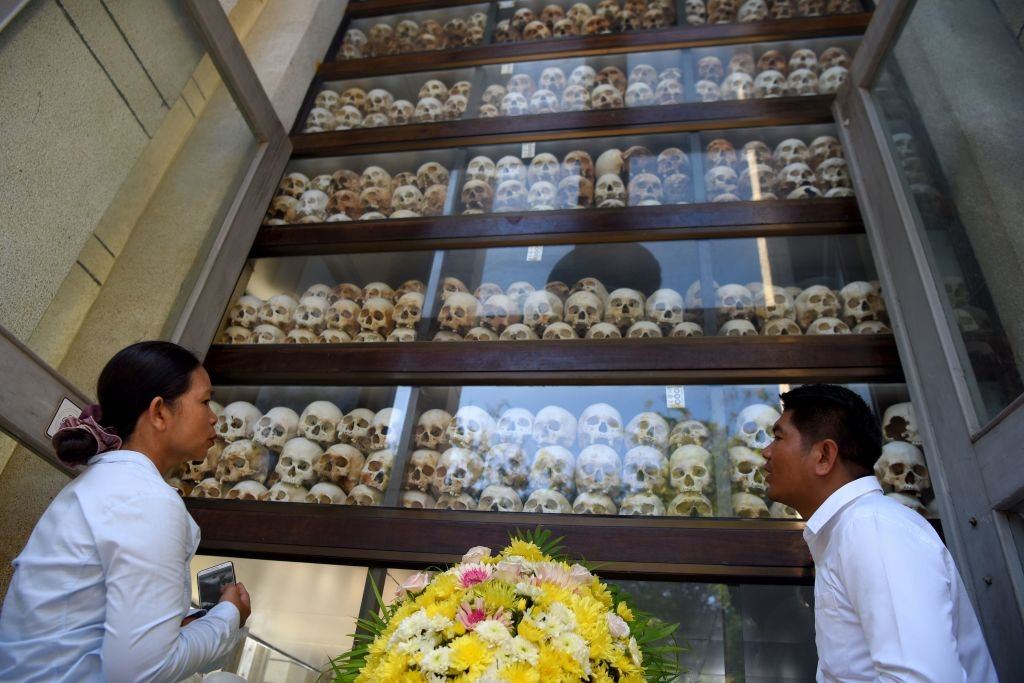
Rows of human skulls, stacked behind glass inside a memorial stupa, confront visitors with the scale of violence remembered at Choeung Ek in Phnom Penh. In the foreground, two people in white pause in quiet attention, their faces turned toward the shelves as if searching for meaning among the remains. A wreath of flowers below adds a fragile note of ceremony, softening the hard lines of wood frames and the cold sheen of the display.
Held during the annual “Day of Remembrance,” the scene underscores how public ritual and private grief meet at Cambodia’s killing fields memorial. The skulls are arranged with an almost archival order, yet the reflections on the glass remind us that the living are always present in the act of looking. Rather than offering distance, the stupa’s transparent walls invite close inspection, turning remembrance into an encounter that is both personal and collective.
For readers interested in civil wars, genocide memorials, and historical memory in Southeast Asia, this photograph speaks to the enduring work of commemoration after mass atrocity. It captures how sites like Choeung Ek function not only as monuments, but as places where families, survivors, and visitors negotiate the past in real time. The image is stark, respectful, and deeply human—an invitation to consider what it means to remember, and why societies choose to preserve evidence in plain sight.