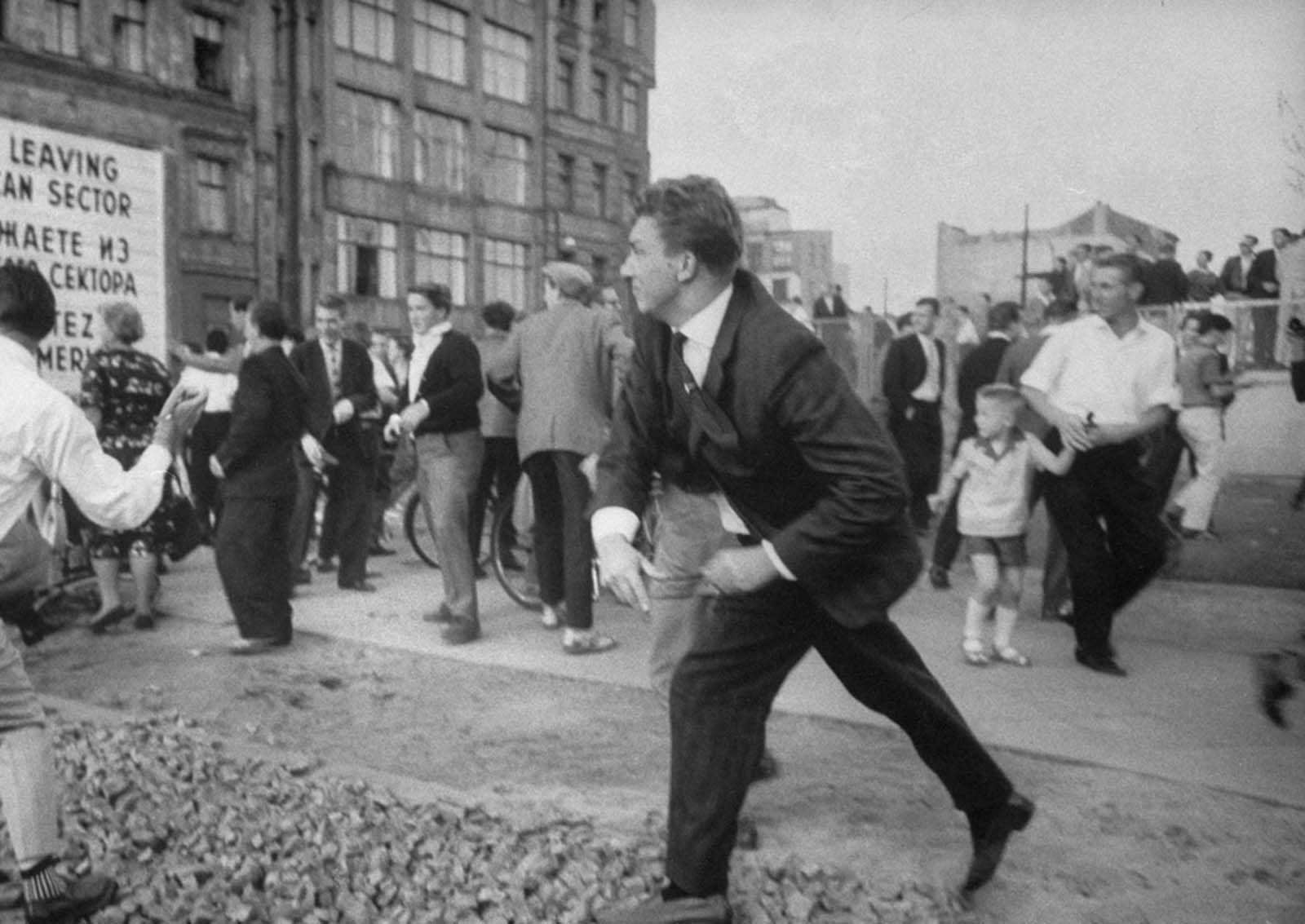
August 1961 brought Berlin to a boil, and the tension is visible here in a split second of movement: a suited man lunges forward with his arm cocked, stones piled at his feet, while a crowd swirls behind him along a hard urban edge of brick buildings and open pavement. Faces turn in different directions, some intent, some startled, as onlookers press toward what feels like an invisible line. A large sign nearby warns about “LEAVING” a sector, underscoring how quickly ordinary streets had become charged checkpoints in a divided city.
Anger—sparked, as the title notes, by taunts from East Berlin police—runs through the scene not as abstract Cold War rhetoric but as lived experience on the ground. The photograph captures the uneasy mix of confrontation and spectatorship: men in jackets, a bicycle in the crowd, and even a child held close, all sharing the same tense space where political boundaries suddenly dictated daily life. The rock-throwing isn’t framed as heroism or villainy so much as raw, immediate reaction to provocation and power.
For readers searching the history of the Berlin Wall’s earliest days, this image offers a stark reminder that the border’s creation was not just concrete and wire, but emotion—humiliation, fear, defiance—played out in public. The street-level drama points to a broader story of how quickly communities can fracture when authority redraws the map overnight. As a historical photo of West Berlin protests in August 1961, it invites reflection on escalation, crowd psychology, and the precarious line between civil unrest and everyday life.