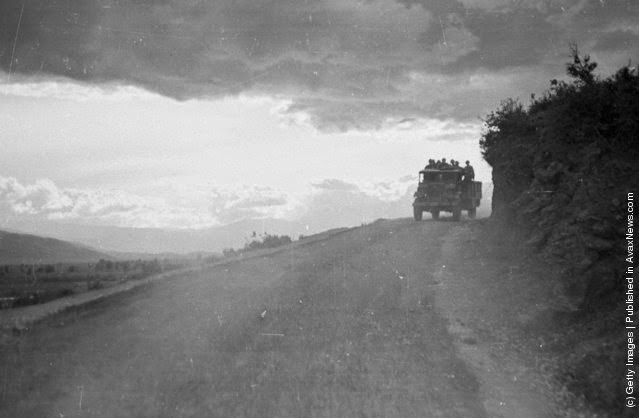
High above the valleys, a single transport truck grinds along a lonely mountain road, its dark outline swallowed by a broad, unsettled sky. The long, bare stretch of track emphasizes how exposed a convoy could feel in Greece’s rugged interior, where every bend and ridge might conceal danger. In the distance, the landscape falls away into hazy fields and foothills, turning the journey into a tense passage between open ground and shadowed cover.
Orders in the Greek Civil War often reflected the brutal arithmetic of night travel: movement after dusk invited ambush, so troops were told to halt and fortify instead of pressing on. The title’s mention of the “last transport of the night” suggests a narrow window of daylight and an urgent need to reach a safer position before darkness changed the rules. Even without close-up details, the photo conveys logistics under pressure—men and vehicles pushed to the edge of visibility, trying to stay one step ahead of guerrilla attacks.
Roads like this were more than scenery; they were lifelines that linked isolated garrisons, carried supplies, and shaped the tempo of operations in a conflict defined by mobility and terrain. The stark composition—one vehicle against a vast horizon—speaks to the vulnerability of government troops on exposed routes and the psychological weight of moving through contested mountains. For readers searching Greek Civil War 1948 imagery, guerrilla warfare history, or wartime transport in mountainous terrain, this scene offers a quiet but powerful glimpse of how strategy and landscape met on the road.