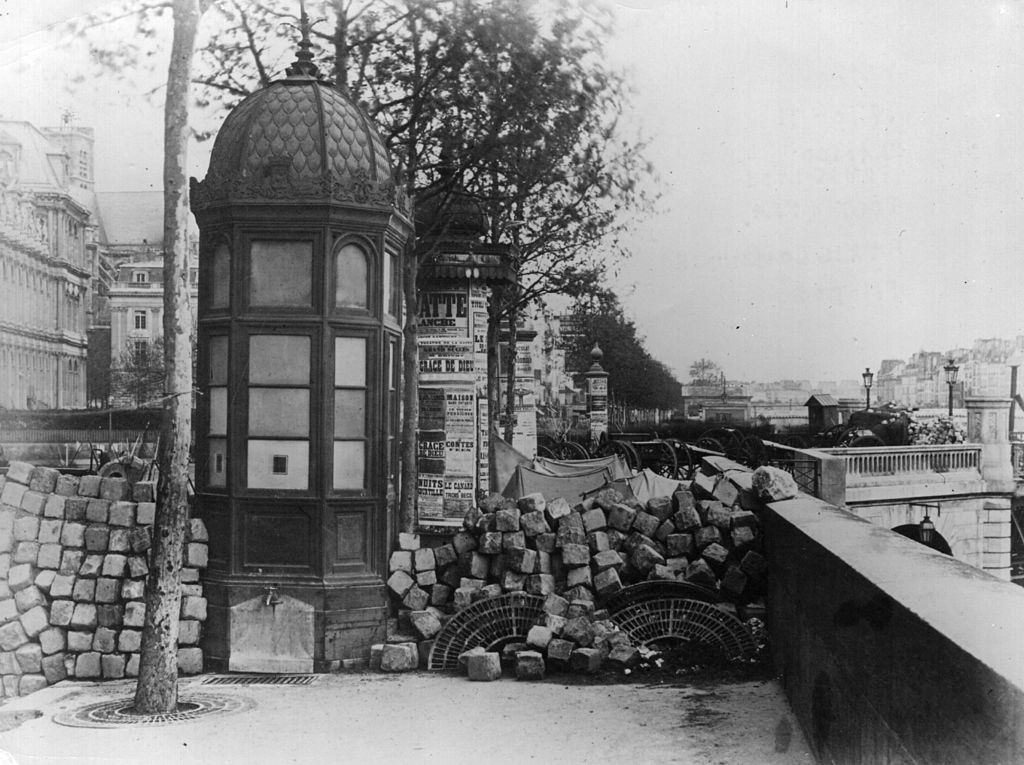
Along the Seine, the familiar order of Parisian street life gives way to an improvised battlefield: heaps of ripped-up cobblestones are stacked into barricades on the Quai Pelletier and near the Pont d’Arcole. A small kiosk stands amid the disruption, its ornamental dome and paneled sides contrasting sharply with the raw, broken stones piled chest-high. Trees, posters, and the line of embankment architecture frame a city turned inward, where everyday fixtures become cover and obstacles.
Barricades like these were more than piles of rock; they were quick answers to sudden danger during the siege of the Paris Commune in 1871. Cobblestones—symbols of modern urban paving—are shown here as ready ammunition for defense, proof of how rapidly public infrastructure could be dismantled when civil war erupted. The scene’s quietness is striking: no crowds, only the aftermath of hurried labor, as if the city is holding its breath between clashes.
For readers exploring Paris Commune history, this photograph anchors the conflict in physical details: stone blocks dragged from the street, wheels and debris tucked behind the barrier, and riverfront space converted into a choke point. It also hints at the Commune’s larger story of revolution and repression without needing a battlefield panorama—just a sidewalk, a bridge approach, and the materials of the city itself. The result is a vivid, SEO-friendly window into 1871 Paris, where cobblestones became fortifications and the urban landscape recorded the pressures of civil wars.