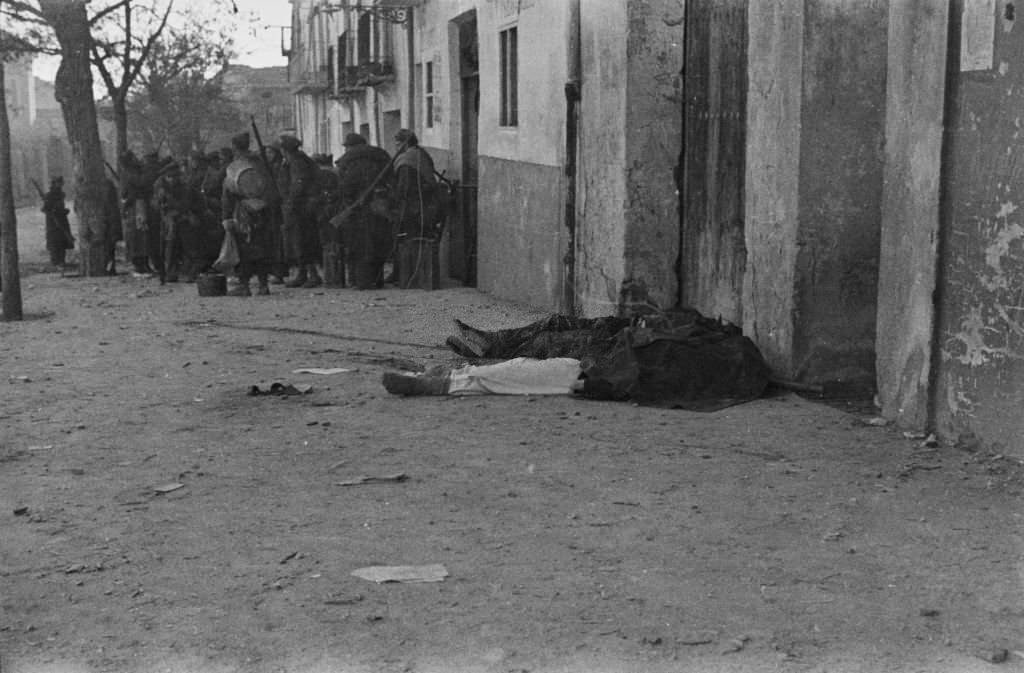
Along a battered street near Teruel on the Aragon front, the aftermath of combat lies in plain sight: fallen Republican soldiers on the ground by a rough plastered wall, while a cluster of armed men gathers farther up the road. The camera’s low angle pulls the viewer into the scene, emphasizing the stillness of the bodies against the hard geometry of doorways and shutters. Dust, scattered debris, and the stark emptiness of the foreground convey how quickly a lived-in townscape could become a battlefield during the Spanish Civil War.
In the distance, figures in heavy coats stand shoulder to shoulder, rifles slung, their attention turned away from the dead and toward whatever task remains—guarding, regrouping, or waiting for orders. Bare trees and scarred façades suggest winter conditions consistent with the Battle of Teruel, a fight remembered for brutal cold as much as for fierce urban and trench warfare. Without relying on captions, the photograph communicates a grim rhythm of war: movement and purpose in one part of the frame, irreversible loss in another.
Few images underline the human cost of civil conflict as relentlessly as this one, taken on 21 December 1937 near Teruel, Aragon, Spain. For readers searching the Spanish Civil War Aragon front, the Battle of Teruel, or Republican soldiers killed in action, the photograph offers a stark primary visual record—unadorned, unheroic, and difficult to forget. It invites reflection not only on tactics and territory, but on the ordinary streets where history’s most violent chapters were written in silence.