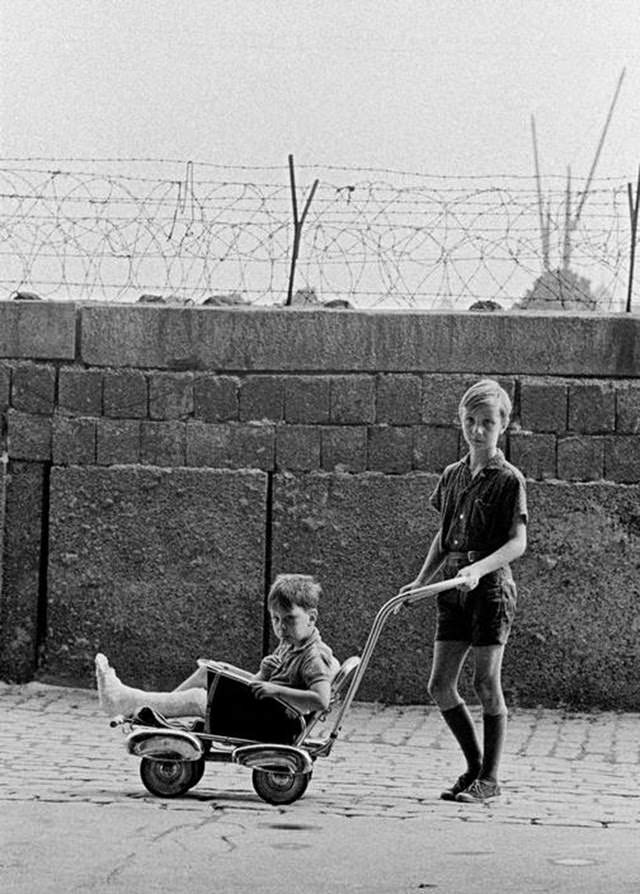
Barbed wire curls across the skyline above a rough line of masonry, yet the street below belongs to childhood for a moment. Two boys turn the pavement into a playground, one perched in a small cart while the other pulls him along, their casual game unfolding right beside the Berlin Wall in Wedding. The contrast is immediate and unsettling: ordinary fun pressed up against a boundary built to intimidate.
The wall’s layered textures—stacked blocks, patched sections, and stark concrete—speak to a city engineered for separation, while the boys’ simple wheels and bare knees suggest improvisation and resilience. Their proximity to the barrier hints at how daily life in West Berlin’s border districts never fully escaped the Cold War’s presence; it simply learned to move around it. Even without dramatic action, the photograph carries tension in every line of fence and every empty space beyond.
For readers searching for Berlin Wall history, everyday life in Wedding, or rare borderland street scenes, this image offers a powerful entry point: politics reduced to infrastructure, and human experience revealed in small gestures. It also echoes the post’s theme of “Civil Wars” in a broader sense—conflict not only fought with weapons, but embedded in neighborhoods, routines, and the childhood memories formed in their shadow. In the end, the photograph lingers because it refuses to choose between innocence and fear; it shows how both could coexist on the same cobblestones.